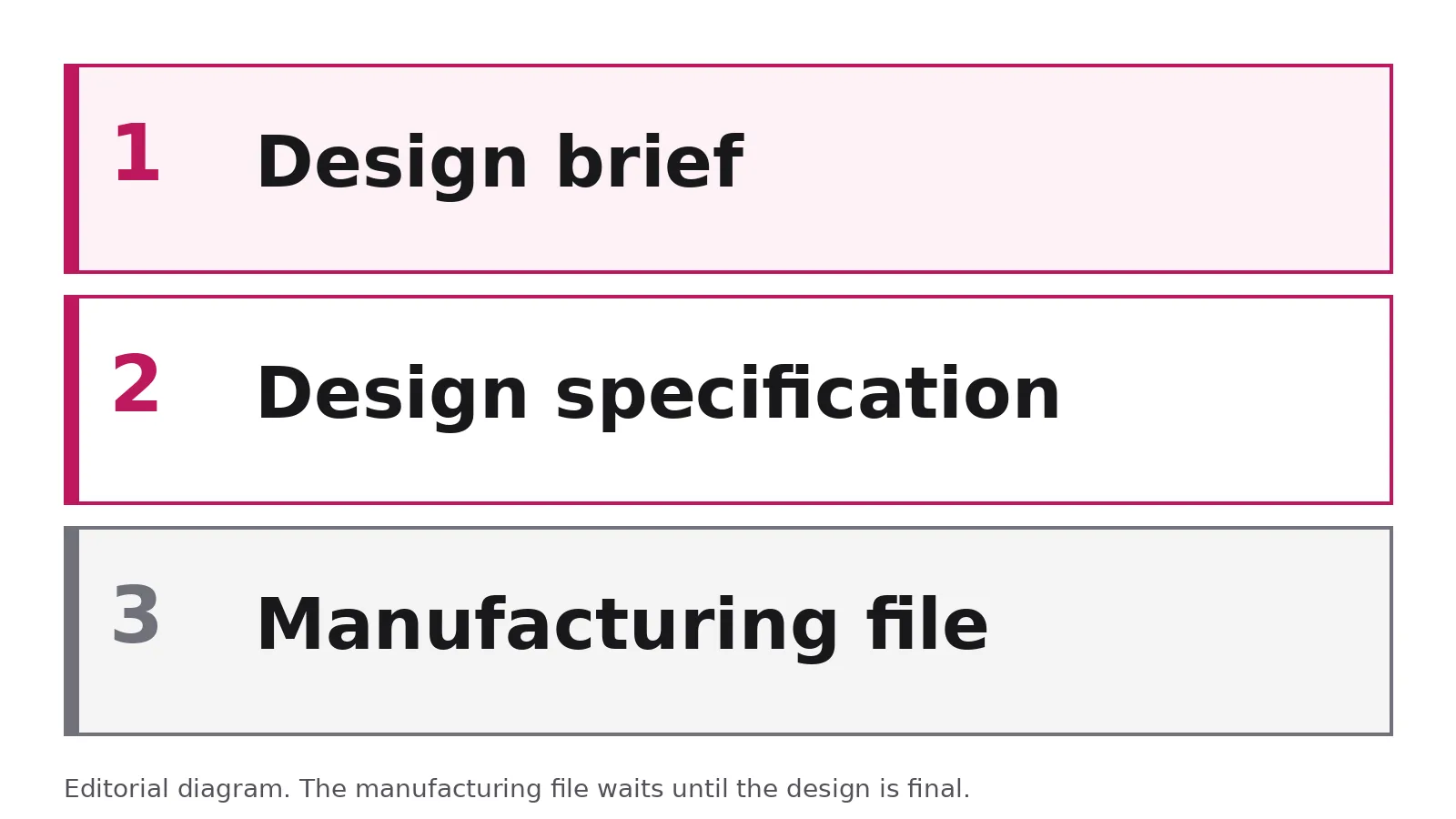
A team that writes “spring clip” into the specification has picked a part and still has nothing it can test. The design brief and the specification do different jobs. Mixing them lets a favorite concept land before anyone has agreed what success looks like.
A design brief states the problem, the user and the situation. A design specification lists criteria the product has to meet, each one tied to something you can observe and a way to check it. BBC Bitesize, in its AQA guide to design briefs and specifications (read 11 October 2026), calls the brief the starting statement and the design specification the criteria you write once research has supplied more facts. A manufacturing specification is a third document, written after the design is final. This page does not produce that file.
You will leave with a comparison of the design brief and specifications, plus a traceability table: where the need came from, a requirement ID, an observable outcome, a check, and anything still unresolved. The worked rows use a fictional desk accessory. Limits nobody has measured stay marked TBD. The example is an editorial exercise, not a client project and not a result from a test we ran.
What is the difference between a design brief and a specification?
The brief opens the problem. The design specification says what a successful product must do. The manufacturing specification, later, tells someone how to make a design you have already chosen.
| Document | What it is for | When it is written | What to keep out of it |
|---|---|---|---|
| Design brief | The problem, who it is for, and the situation | At the start. BBC Bitesize: the client gives it, or the designer writes it for the client | The part you hope to build |
| Design specification | Criteria you can use to judge ideas | After research has supplied more facts (BBC Bitesize) | A frozen concept, or a number you never measured |
| Manufacturing specification | Enough for a third party to make the product | After the design is final (BBC Bitesize) | The job of the criteria. Drawings come later |
BBC Bitesize describes a design brief as the statement a client gives a designer about the product they want. Its example is a drinks-bottle holder for use while riding a bicycle. The same page says the designer can write the brief when the client has a problem and has not said how to proceed. A design specification, on that page, is the list of criteria the product needs to address. Measurable criteria make it easier to judge ideas later. The page names the kinds of criteria to cover: aesthetics, function, materials, environmental issues, performance and target market. Its illustration of a measurable question is what the design will cost to produce. That is a question to answer with a quote. This page has no price to give you.
StudyRocket’s Eduqas revision notes, read the same day, put the split in student language. The brief identifies the problem and the design objectives. It summarizes scope and includes the target audience, the purpose, the context and the timescale. It does not hand you the solution. The design specification describes the criteria the solution must meet. StudyRocket lists performance, available resources, constraints, safety standards and environmental issues among the things that document can hold. StudyRocket also calls the specification a working document you review as the project moves.
Design Council’s history of the Double Diamond uses “design brief” for a later moment. In the Define phase, the team makes sense of research and writes a brief that states the challenge from those insights. Read that next to the BBC starting statement. A short client note can open the project. Research can force you to rewrite the brief so the challenge is actually clear. The criteria still wait until you can say what you would observe.
Takeaway: Keep three files apart: a brief for the problem, a design specification for testable criteria, and a manufacturing specification only after the design is final.
How do you turn one need into a requirement you can test?
Give every criterion an ID, name the note it came from, write the outcome someone can see, and name the check. If a limit is still unknown, write TBD in that cell. Leave the cell empty of borrowed numbers.
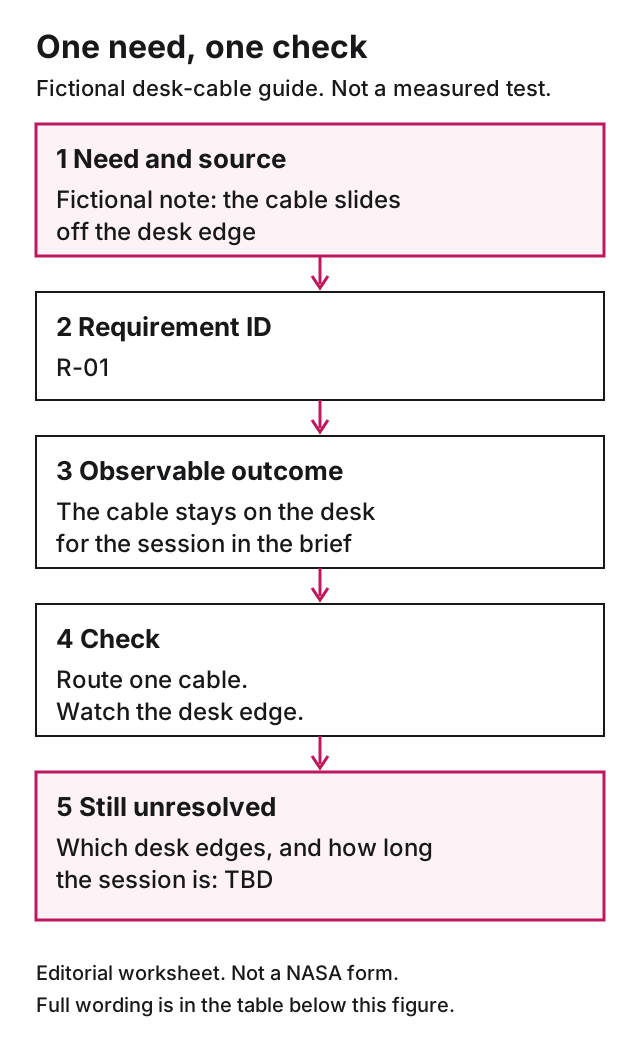
NASA’s Appendix D, Requirements Verification Matrix (page read 11 October 2026), is written for aerospace systems engineering. It says that when you develop requirements you should decide how you will verify them. The example matrix includes only “shall” requirements. Each one gets a unique identifier, and the matrix names the document the requirement came from. An ID, a source and a verification approach are the three habits a student team can copy. The sheet below is an editorial worksheet for a small hardware project. NASA has not approved it, and it is not a NASA form.
A design brief and specification example
The project is fictional. Picture a shared study desk. The people there already own a laptop and a charging cable. During a seated work session the cable slides off the desk edge.
Write the brief as the problem only:
Design a small accessory for a shared study desk so a laptop charging cable stays on the desk through a seated work session. The people at the desk already own the cable and the laptop. Leave clip, material and size unnamed.
“Use a steel spring clip” can wait on a concept list. The clip might later pass or fail the requirement. The sentence is not the requirement.
| Need and source | ID | Observable outcome | Check | Still unresolved |
|---|---|---|---|---|
| Fictional observation: during a seated session the charging cable slides off the desk edge | R-01 | The cable remains on the desk surface for the whole seated session the brief names | Put the accessory on one desk edge, route one cable the way the note describes, and watch whether the cable leaves the surface | Which desk-edge shapes count, and how long the session is, stay TBD until you measure them |
| Fictional constraint in the brief: the laptop must still sit flat on the same desk | R-02 | A closed laptop sits flat beside the accessory, with no rock and no lifted corner | Place a closed laptop on the desk next to the accessory and look along the desk surface | Which laptop sizes count is TBD. The check names no clearance |
Sentences that feel like requirements and belong somewhere else:
| Sentence | Where it goes |
|---|---|
| Use a steel spring clip | Concept list. You can test this concept against R-01 later. It does not replace R-01 |
| A load, a grip depth or a duration that the notes never recorded | Unresolved column, written TBD. A filled-in number would invent a threshold |
Takeaway: A requirement names an outcome and a check. A part name stays on the concept list until that check exists.
What do you copy for your own project?
Copy the empty row, one need at a time. Stop when you cannot name the source note or the check. That row is not ready to steer a concept.
| Need and source | ID | Observable outcome | Check | Still unresolved |
|---|---|---|---|---|
| Your note, and where it came from | R- | What a person can see or do | The check you will actually run | What you have not measured. Write TBD |
Read the row back as one sentence: “Because of [source], R- shall [observable outcome], checked by [method]. Unresolved: [TBD].” NASA’s matrix uses “shall” so each requirement is a statement you can verify, not a wish. If your sentence still names a mechanism, move that mechanism to the concept list. If the only way to finish the sentence is to invent a measurement, leave TBD.
BBC Bitesize’s criteria list (aesthetics, function, materials, environmental issues, performance, target market) is a prompt for the kinds of needs to look for. It is not a demand that every student project fill all six on the first day. A row with a source and a check is worth more than six headings with no observation behind them.
Takeaway: One sourced, checkable row is a specification entry. A list of hoped-for features is still a brief, or a concept list.
What do you do with a finished row?
Build the next model to answer one row. The rapid prototyping loop starts by writing the question that model must answer. For this fictional guide the first question is whether the cable stays on the desk through the session, on the edge you actually have. A print that only displays the spring clip you already prefer has not checked R-01.
When you write the project up, keep the table next to the sketches. The industrial design portfolio guide treats research and rough models as evidence of how you decided. This table is that evidence: which need you accepted, which idea you refused to call a requirement, and which limits you left open.
The manufacturing specification waits. BBC Bitesize says it is created after the design is finalized and should hold enough for a third party to manufacture the product: a detailed drawing with dimensions, a parts list, and the order of production, including quality checks and tolerances. Write that file after a concept has met the criteria.
Takeaway: Test one requirement ID at a time. Leave drawings, parts lists and tolerances for the manufacturing specification.
How this page was put together
Compiled on 11 October 2026 from four public pages: BBC Bitesize on design briefs and specifications (AQA), StudyRocket’s Eduqas GCSE revision notes on the same topic, Design Council’s history of the Double Diamond (Define phase), and NASA Appendix D on a requirements verification matrix. The comparison and the five-column sheet are our editorial exercise. The desk accessory is invented so the method has a concrete need to convert. No threshold on this page comes from a measurement, a lab or a client project. NASA’s appendix is aerospace guidance used here only as a method.
Takeaway: Use the table on your own notes. Confirm any standard, cost or safety limit in the document that actually states it.