A stage-gate milestone is a decision to spend the next block of time and money, written before that block starts. Stage-Gate International’s overview, read 20 October 2026, splits the work into stages and the decision into gates. NASA’s systems-engineering appendix shows how to write the two lists a review needs. A hardware studio can use both structures and still set its own numbers.
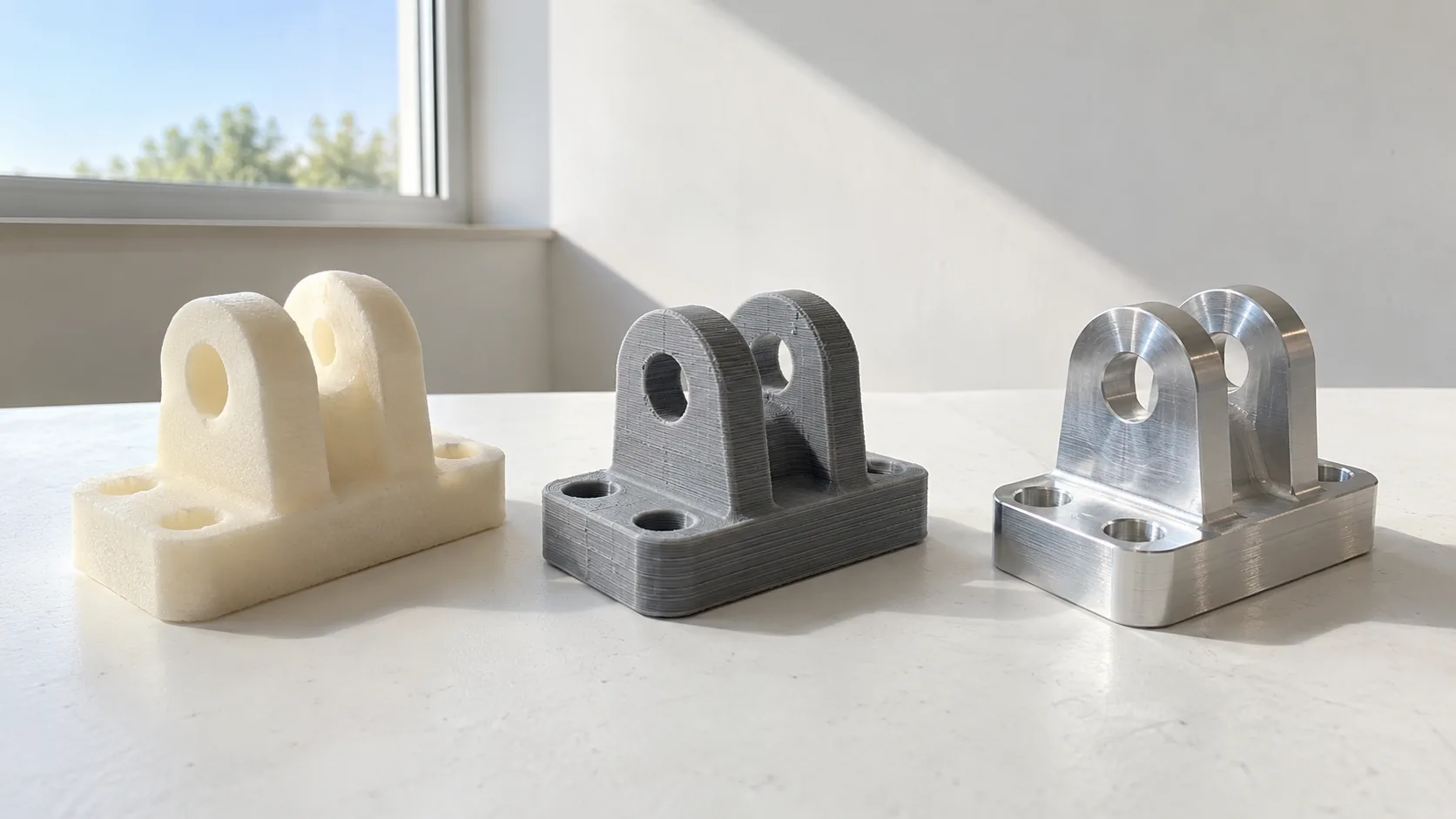
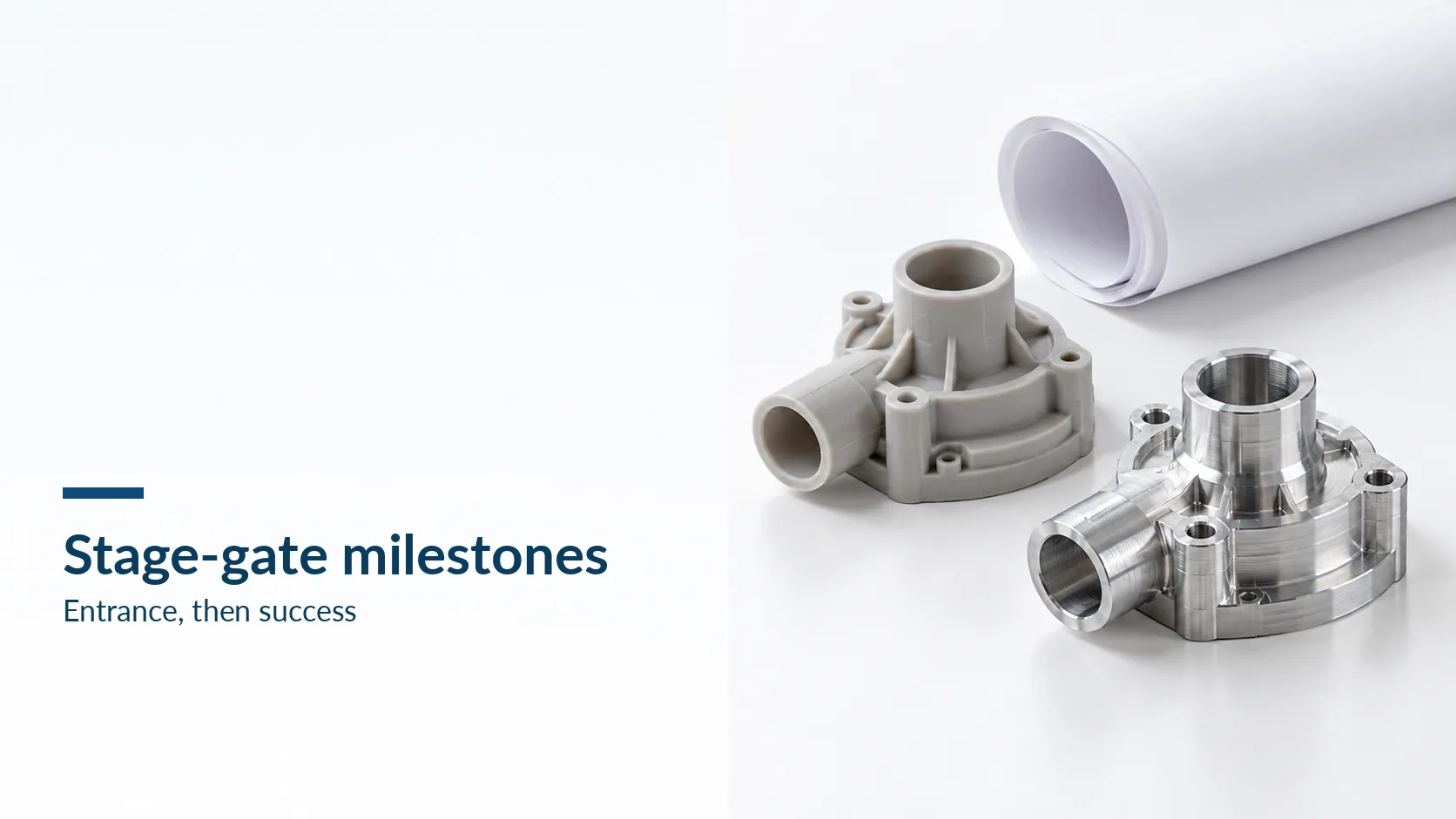
Three fidelities on one bench: a sketch, a printed shape, and machined parts. Only the build that can be tested belongs at the development gate.
Name the stage before you name the prototype count
Stage-Gate International describes discovery plus five stages for a major new product. Discovery uncovers opportunities. Stage 1, concept, is a quick market and technical look and ends with an articulated concept. Stage 2 builds the business case: primary research, a value proposition, a financial evaluation, and a plan for the next stage. Stage 3 is detailed design and development. The deliverable named on that page is a fully functioning prototype, or the equivalent, ready for customer and field testing. Stage 4 tests the product, the offer, and the production system with beta tests, pilots, field trials, and a trial production run. Stage 5 is launch and ramp-up, through a post-launch review.
The same page says the picture looks linear and the work is not. Iteration inside a stage, and often between stages, is part of the description. The gate is still held against deliverables that were specified in advance.
| Gate | Deliverable the previous stage owes | Dominant failure mode and prevention |
|---|---|---|
| Into concept | A stated opportunity, not a solution sketch presented as a requirement | Building a shape before the problem is written. Prevent it with the brief versus specification split. |
| Into development | A business case: product definition, position, financials, and the plan | A favorite concept with no evidence. Prevent it by refusing the gate when the case is a slide. |
| Out of development | A functioning prototype ready for a customer or a field test | A looks-like model booked as done. Prevent it by naming the test the prototype must survive. |
| Into launch | Beta, pilot, or trial-production evidence that operations can deliver | A launch date with no trial run. Prevent it by keeping Stage 4’s trial on the critical path. |
Rule of thumb: if the prototype cannot yet be put through the customer or field test named for Stage 4, it is still in development. Stage-Gate International places that functioning prototype at the end of Stage 3, not at the kickoff of tooling.
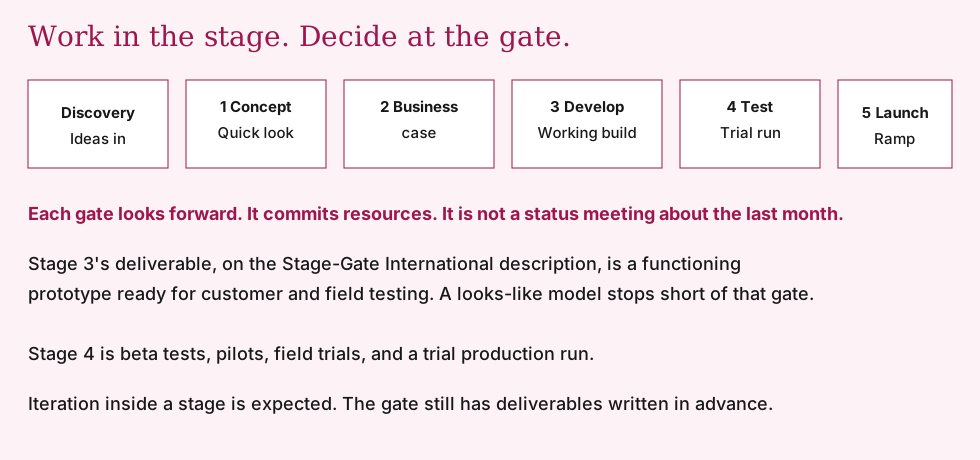
Discovery feeds five stages. The gate before each stage is the decision to continue spending.
Borrow NASA’s two columns, not NASA’s review board
NPR 7123.1D Appendix G, effective 5 July 2023 and expiring 5 July 2028, is mandatory for NASA employees. It describes entrance and success criteria for life-cycle and technical reviews. Entrance criteria are not a complete list of every product and its maturity. Success criteria, with the entrance list, are aimed at technical maturity, the adequacy of the technical plan, and the credibility of budget, schedule, and risk, plus readiness for the next phase.
Appendix G.1.2 says tailoring is expected. The decision not to tailor should be justified. A product studio that copies a NASA table verbatim, including flight-review products it does not have, has skipped the instruction the appendix actually gives.
Use two columns at the studio’s own gate:
- Entrance: the files that must exist before the meeting is scheduled. A missing file postpones the meeting.
- Success: the statements that must be true before money is released. A failed statement kills the project or sends it back.
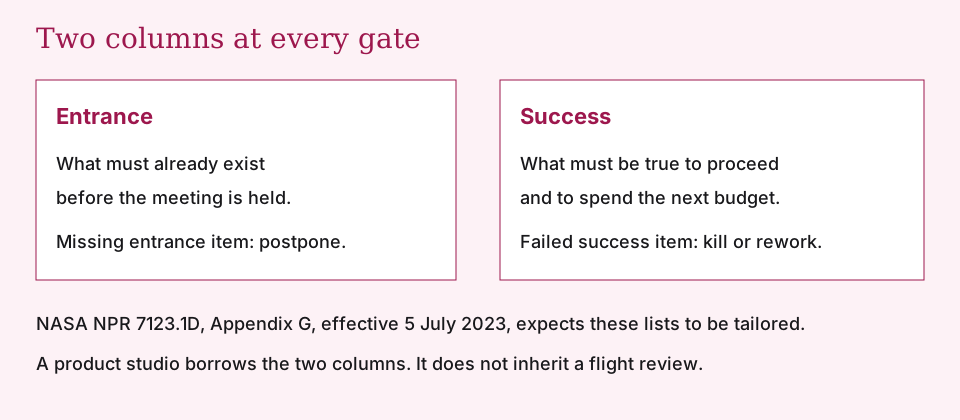
Entrance opens the meeting. Success releases the next phase. Tailor both lists to the product in front of you.
The design brief versus specification page is the entrance file for Stage 1: the brief states the problem, and the specification states what a test can check. The manufacturing specification handoff waits until a concept has met those checks. Putting the manufacturing file at the concept gate is how a studio spends tooling money on a requirement that is still marked TBD.
Worked example: how many units the test itself consumes
The Stage-Gate description does not set a prototype quantity. The quantity is the sum of what the named test destroys and what the record must keep.
Units to build = units the test destroys + units retained + spares
Worked example: a drop test destroys 2 units, the team retains 1 untested unit with the report, and the plan holds 1 spare. 2 + 1 + 1 = 4 units before that gate. A plan that builds 1 unit has no retained sample after the drop. The failure mode is a broken prototype and no record of the build that broke. Prevent it by writing the three terms before the shop order.
Change the test and the sum changes. A trial production run that consumes a full cavity shot is a different equation, with the shot size in place of the drop count. Leave the number as TBD until the test method is named. NASA’s appendix makes the same point about maturity: the review list is tailored because the products are not universal.
Where the money leaks
Stage-Gate International describes the spend as rising with each stage while the information improves. The leak is a gate that releases the next budget because the calendar said so. The prevention is the success column. If the trial production run in Stage 4 has not happened, the launch budget stays unreleased. Rework of a tool cut from a looks-like model is the cost this page is trying to keep on the development side of the gate, where a change is still a file and not steel.
Method and sources
Stage names and deliverables are from Stage-Gate International, “The Stage-Gate Model: An Overview,” retrieved 20 October 2026. Entrance and success criteria, the effective date, and the tailoring instruction are from NASA NPR 7123.1D Appendix G, effective 5 July 2023. The unit count is arithmetic on stated inputs. This site is not Stage-Gate International and not NASA, and it does not run these reviews. Reviewed 20 October 2026.