A vague comment wastes the next model on taste. Record each remark on this fictional wooden channel as an observation, a question, and the next check, and leave every score blank.
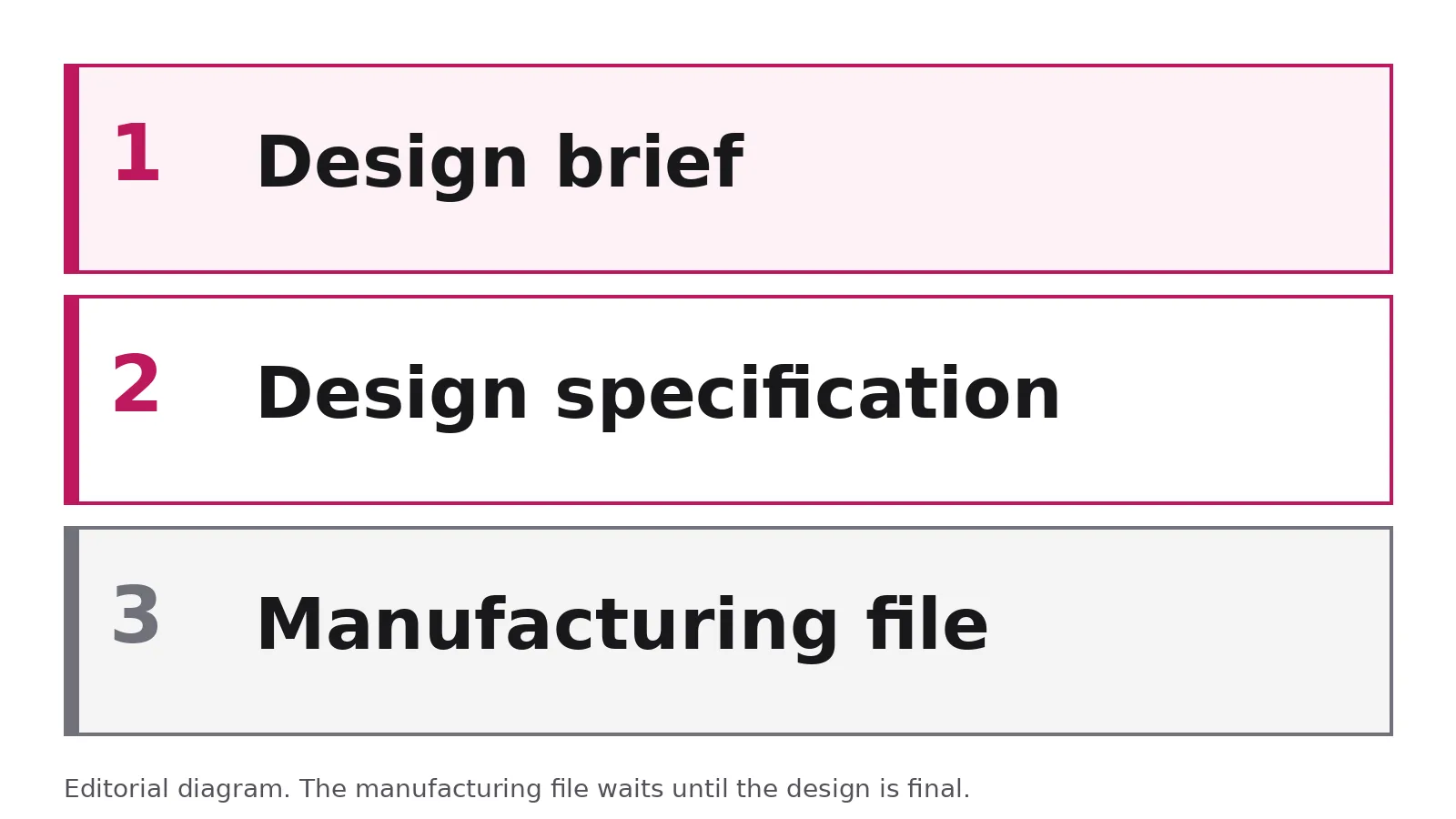
An industrial design critique example, on this page, is a log for one unfinished physical model. Sarah Gibbons, in Nielsen Norman Group’s “Design Critiques” (23 October 2016, copy saved 11 October 2026), defines a critique as feedback on whether a design meets its objectives. She separates a standalone critique, whose purpose is to improve one piece of work, from a design review held to approve the work and move on. The objective here is already written as fictional requirement R-01 on the design brief and specification worksheet: a charging cable stays on one desk through one seated session. The only object in the room is an unfinished wooden channel. Scores, ratings, and a winning concept stay empty. A drawing on a sheet of paper is not that channel, and neither picture is a watched session.
You leave with the log, a short recap, and the one check still to run. The comments are written for the exercise. This site held no critique and watched no session.
| Item | What this example uses | Why it matters |
|---|---|---|
| Session type | Standalone critique. Gibbons, 23 October 2016: improve one piece of work, rather than approve a finished design. | Comments about a different product are out of scope. |
| Objective | Fictional R-01: the cable stays on the desk through one seated session. | A remark that ignores this objective has nothing to act on yet. |
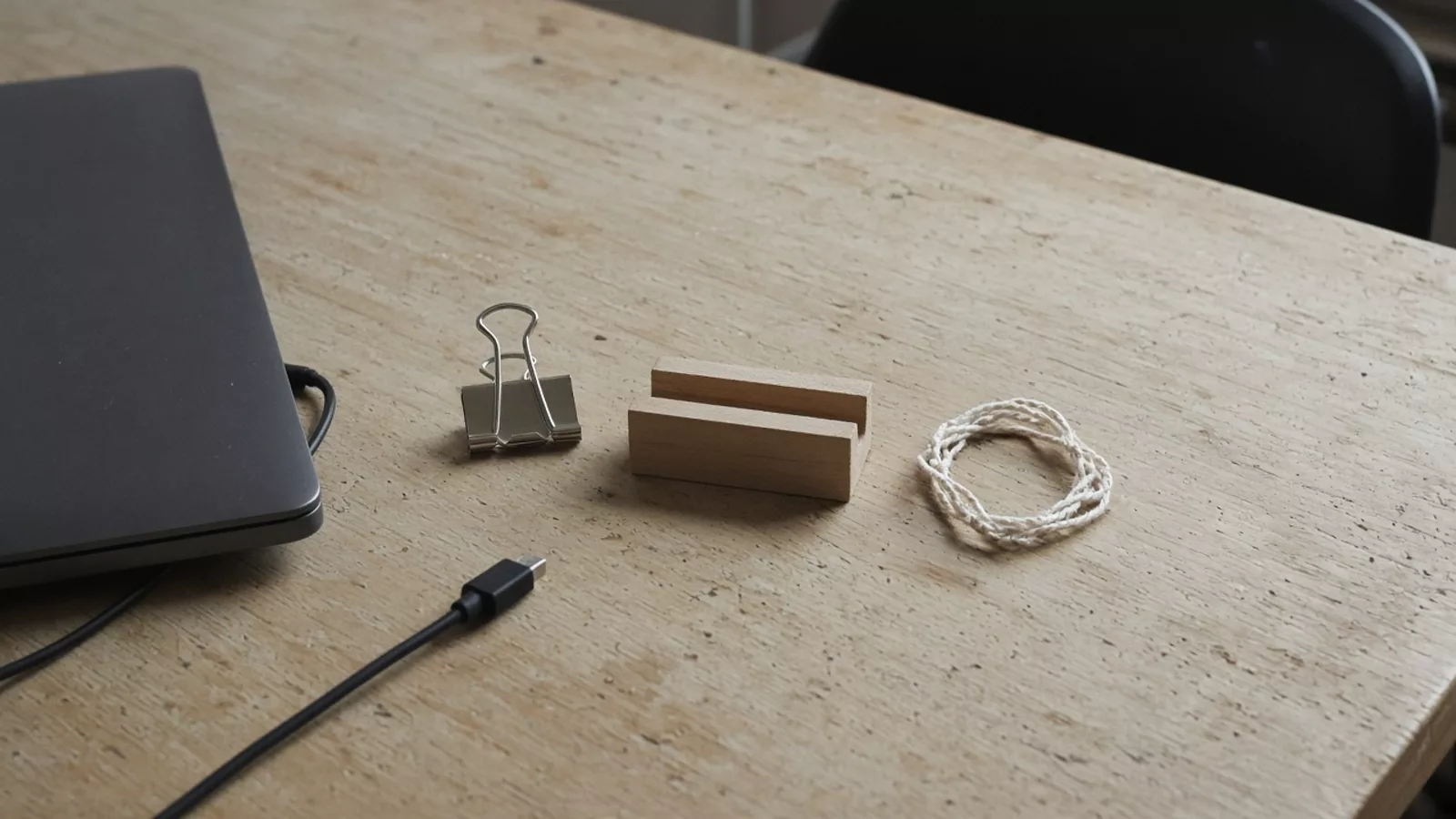
| Object in the room | One unfinished wooden channel. The clip and the cord loop from the blank comparison sheets are not in this room. | One model. Not a ranked set. |
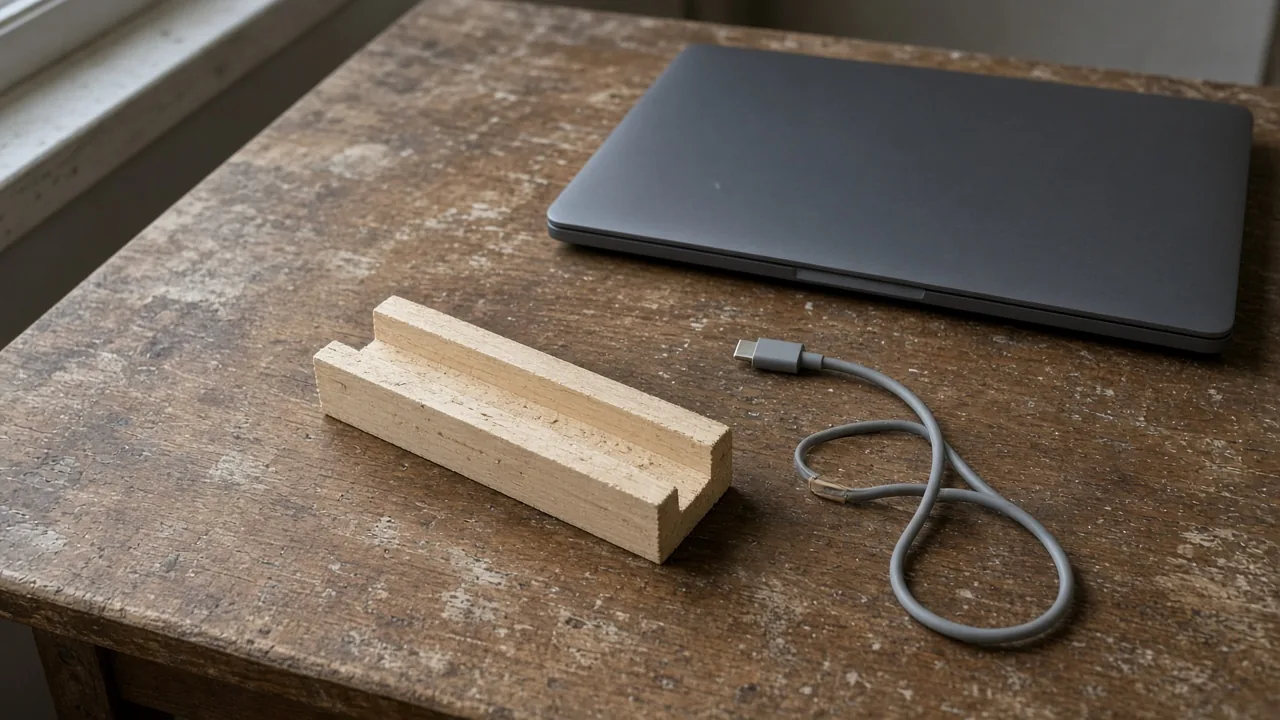
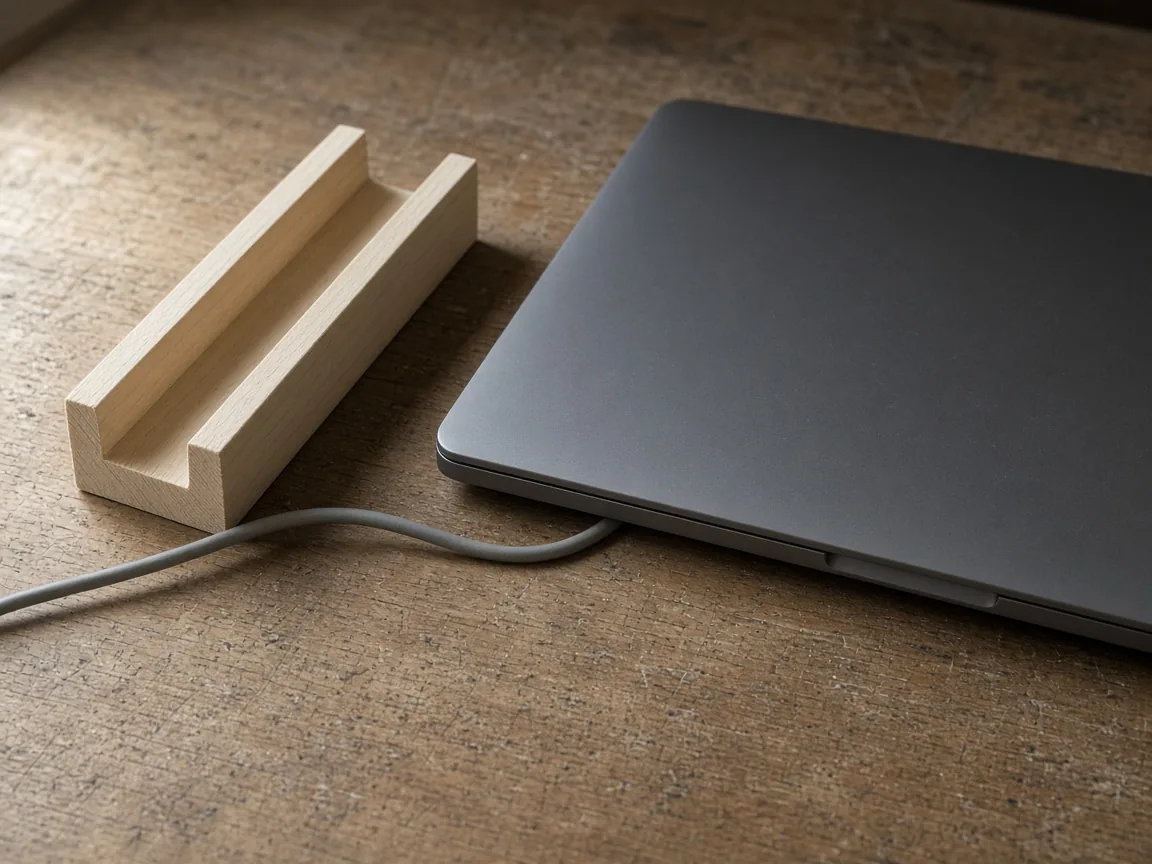
| What a look can record | The cable lies outside the empty groove, beside a closed laptop. | That is a description of the model. It is not a session. |
| Next evidence | One seated session. The laptop stays closed. | The cable-stay cell stays blank until that note exists. |
| Score, rating, winner | A blank is not a zero, a tie, or a win. |
What has to be agreed before the comments start?
Gibbons writes that feedback is subjective and baseless without agreement on the problem. She also treats conversation, rather than command, as a condition of the critique. The presenter repeats the objectives before comments start. On this page those lines are fixed before anyone speaks.
| Bound | This exercise | Still open |
|---|---|---|
| Objective | The cable stays on the desk through one seated session. | How long that session is, and which desk edges count, stay TBD on the specification worksheet. |
| In the room | The unfinished wooden channel, the cable, and the closed laptop. | |
| Out of this session | A new laptop, a new cable, and any ranking against the clip or the cord loop. | |
| Who writes the note | The presenter, Gibbons’s name for the person who brought the work. | No second owner is named. |
If your own objective is still an untagged guess, stop and use the one-page product design brief. That sheet marks observed, sourced, assumption, and unknown before a model enters the room. This log starts after R-01 exists.
Takeaway: Agree the objective and the object before the first remark. A comment about a different product is a different meeting.
Which comments are too weak to act on?
Slide Nine’s page, read from the copy saved 11 October 2026, says specific is better than vague, and it uses “make it look nice” as the vague case. The same page asks whether the piece meets the goals, serves the audience, and suits the context, including budget, materials, and whether it functions as expected. Gibbons shows the same move on an interface: she rewrites “Yikes… that layout!” as a question about whether the layout helps the user finish the task. That button example is hers. It is not a note about this channel.
| Comment | What is missing | What to write instead |
|---|---|---|
| Make it look nice. | Slide Nine: “nice” is relative. No feature, no objective. | Which feature on this channel are you looking at? |
| Make it look more designed. | Taste. Gibbons: without the objective, the remark is baseless. | The cable is outside the groove. Does that matter for R-01? |
| I would have used metal. | A command, and a material with no check. | Leave the material cell blank until the cable-stay session exists. |
| The cable is sitting outside the groove, next to the closed laptop. | Nothing is missing. It points at the model. | Keep it, then ask for the session that R-01 names. |
Antara Bhargava’s Bootcamp article (23 October 2022) sorts interface critique into micro, macro, and contextual levels: elements, the flow, and the pain points. The direct page returned HTTP 403 in the 11 October 2026 fetch. The sentence above is from the indexed snapshot saved with that fetch. Those three levels do not say whether a cable stays in a groove.
Takeaway: Keep the comment that points at the model. Rewrite or park the comment that only names a taste or a material.
What does the log record for this wooden channel?
Each row is objective, observation, question, next evidence, and owner. Gibbons says the session notes should include the action items. Rachel Krause, in “Closing the Loop” (22 May 2026, same saved copy), says the follow-up has to say what was heard and what happens next. The columns below are an editorial sheet for that pair of instructions. They are not a copy of either article’s screenshot.
| Comment | Objective | What the model shows | Question | Next evidence | Owner |
|---|---|---|---|---|---|
| The cable is outside the groove. | R-01. The cable stays on the desk through one seated session. | The grey cable lies outside the empty groove, beside the closed laptop. A look at the model. Not a watched session. | Can the cable go into the groove without moving the laptop, and does it stay for the session? | One seated session on this desk. The laptop stays closed. Write whether the cable leaves the desk, and whether the laptop moves. | Presenter |
| Make it look more designed. | Which feature on this channel is the comment about? | ||||
| I would have used metal. |
Read an empty cell as empty. Do not treat the gap as zero, and do not treat a material preference as a result.
| Score | Rating | Winning concept |
|---|---|---|
The clip and the cord loop stay on the blank comparison sheets. A comment in this room does not write a plus, a weight, or a winner on those sheets.
Takeaway: One row is ready to act on. The other two stay blank until they name a feature and a check.
What can the drawing show, and what stays blank?
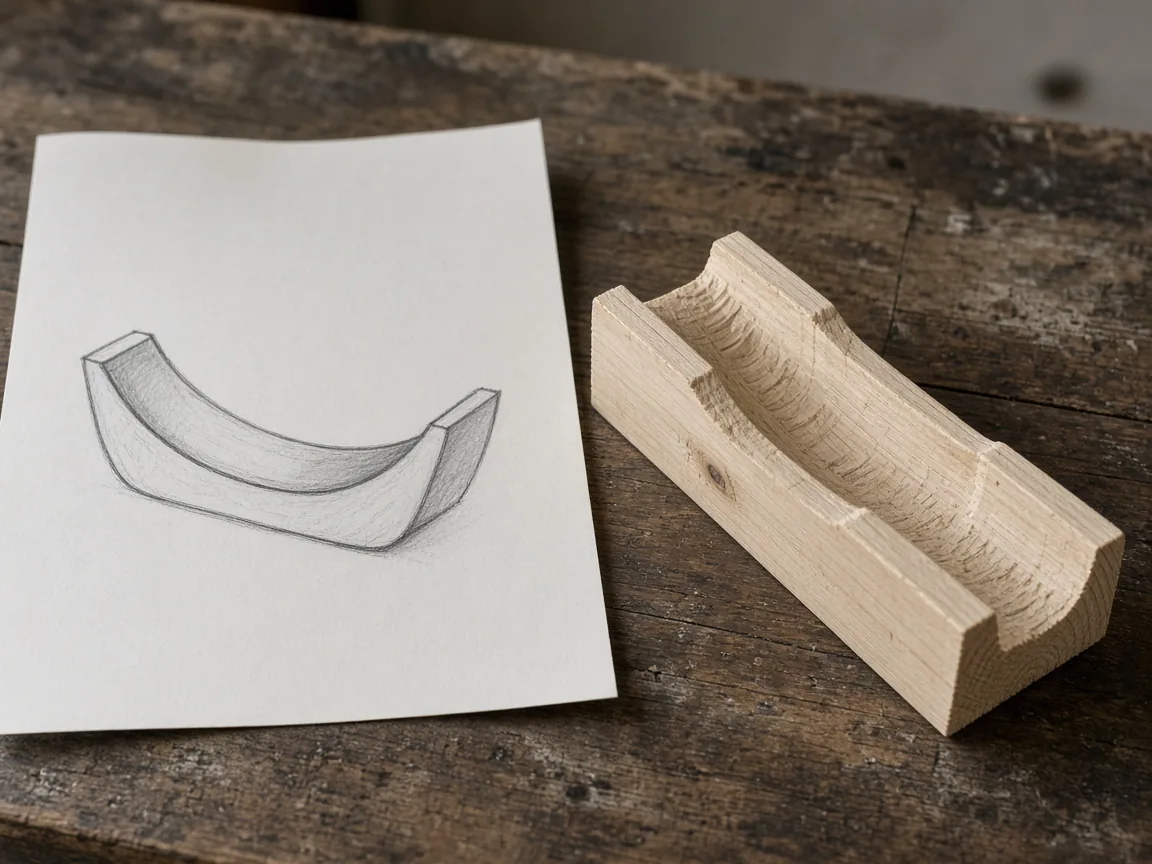
Stanford Biodesign’s Prototyping: Build, v1, on the page numbered 17 in the copy saved 11 October 2026, argues for interim design documentation even when the next iteration will change the design. For a mechanical build, that page says a few annotated photographs, with arrows, a caption, and a parts and materials list, can document the build, and that a CAD image can be paired with them. The guide is © 2021 Stanford University. This page is not a Stanford form, and the photographs here have no arrows and no labels. The notes sit in the table.
| Object in the photograph | What a person can say from looking | What stays blank |
|---|---|---|
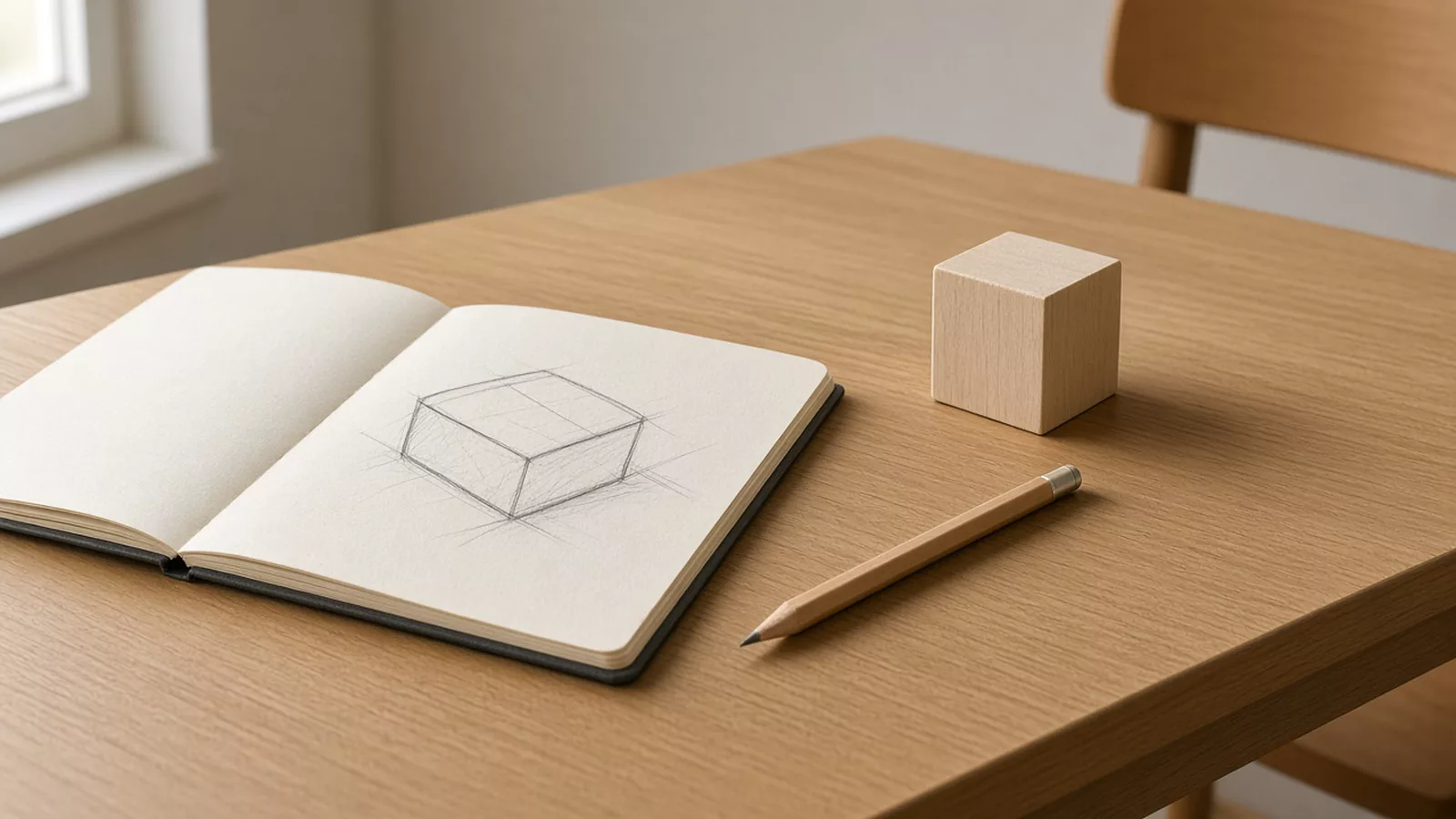
| Pencil drawing of a curved trough on paper | The paper shows a curved trough. It is not the wooden piece beside it. | Whether a cable stays. There is no cable on the paper. |
| Unfinished wooden channel | The piece is pale, unfinished wood, with an open groove. | Species, cost, and any strength number. |
| Grey cable outside the groove | The cable is not in the groove in this picture. | Whether it stays there through a seated session. |
| Closed laptop | The lid is shut, next to the channel. | Whether the laptop moves when someone sets the cable in the groove. |
| Parts and materials list, Stanford’s mechanical-build note | Channel: unfinished pale wood. Also on the desk: one grey cable, one closed laptop, one sheet of paper. | A CAD file. This page does not have one. Budget. |
Slide Nine’s context questions, applied to this model:
| Question on that page | This example |
|---|---|
| Does it meet the goals? | The goal is R-01. The answer cell waits on the session. |
| Does it serve the audience? | The fictional brief says the people already own the cable and the laptop. No other audience is named. |
| Does it fit the budget? | |
| Materials | The model is unfinished pale wood. “Use metal” does not fill a cell. |
| Does it function as expected? | No session has been watched. |
Takeaway: A drawing and a photograph can show the groove and the cable’s place in the picture. They cannot show that the cable stayed.
What does the follow-up say when no session has been watched?
Krause’s immediate recap is short on purpose. She gives the shape as what the team is moving forward with, what it is still investigating, and what it has decided not to pursue. Her article then uses four lines: name the feedback, state the decision, give the reason, indicate what happens next. Her worked scenes are a dashboard and a checkout step, including a usability-test claim that belongs to those scenes. Those claims are not results for this channel. The recap below uses her four lines on the hypothetical model, and it stops where the session is missing.
| Krause’s line | Hypothetical recap |
|---|---|
| Name the feedback | The cable lies outside the empty groove, beside the closed laptop. |
| State the decision | Still investigating the same channel. Not changing the material in this session. |
| Give the reason | No seated session has been watched. The drawing and the photographs do not show whether the cable stays. |
| What happens next | The presenter watches one session with the laptop left closed, and writes whether the cable leaves the desk and whether the laptop moves. |
| Score or preferred concept |
Gibbons lists rushing to solve the problem in the room as a pitfall. The metal comment is that rush. It waits.
Takeaway: Send the recap with the blank cells still blank. The next meeting starts from the session note, not from a new material.
When does this log not apply?
Gibbons’s design review, the meeting that approves a design and moves on, is a different session. This sheet does not grant that approval.
A comparison among the channel, the clip, and the cord loop belongs on the blank sheets. Do not convert a remark into a plus.
A requirement that still lacks an observable check belongs on the specification worksheet. This page does not invent the session length or the desk-edge sizes that worksheet left TBD.
An objective that is still an untagged guess belongs on the one-page brief, before this log.
Interface comments about buttons, navigation, and checkout flows are the examples in the Nielsen Norman Group articles and in Bhargava’s snapshot. They are not observations of this channel.
Takeaway: Use the log for comments on this one unfinished model. Ranking, approval, and an untagged brief are other pages.
How this page was put together
Compiled on 14 October 2026 from copies saved 11 October 2026. Sarah Gibbons, “Design Critiques,” Nielsen Norman Group, 23 October 2016. Rachel Krause, “Closing the Loop,” Nielsen Norman Group, 22 May 2026. Stanford Biodesign, Prototyping: Build, v1, the page numbered 17, section “The Case for Interim Design Documentation,” © 2021 Stanford University. Slide Nine, “How to Give a Helpful Design Critique”; that copy shows no publication date. Antara Bhargava, Bootcamp, 23 October 2022, from an indexed snapshot, after the direct fetch returned HTTP 403. A forum thread on critique from non-design stakeholders was read in the same save and has no physical-model log. One other result page returned HTTP 451 and was not used. The channel, the comments, and the recap are an editorial exercise. No cell on this page is a score, a rating, or a winning concept from a test.