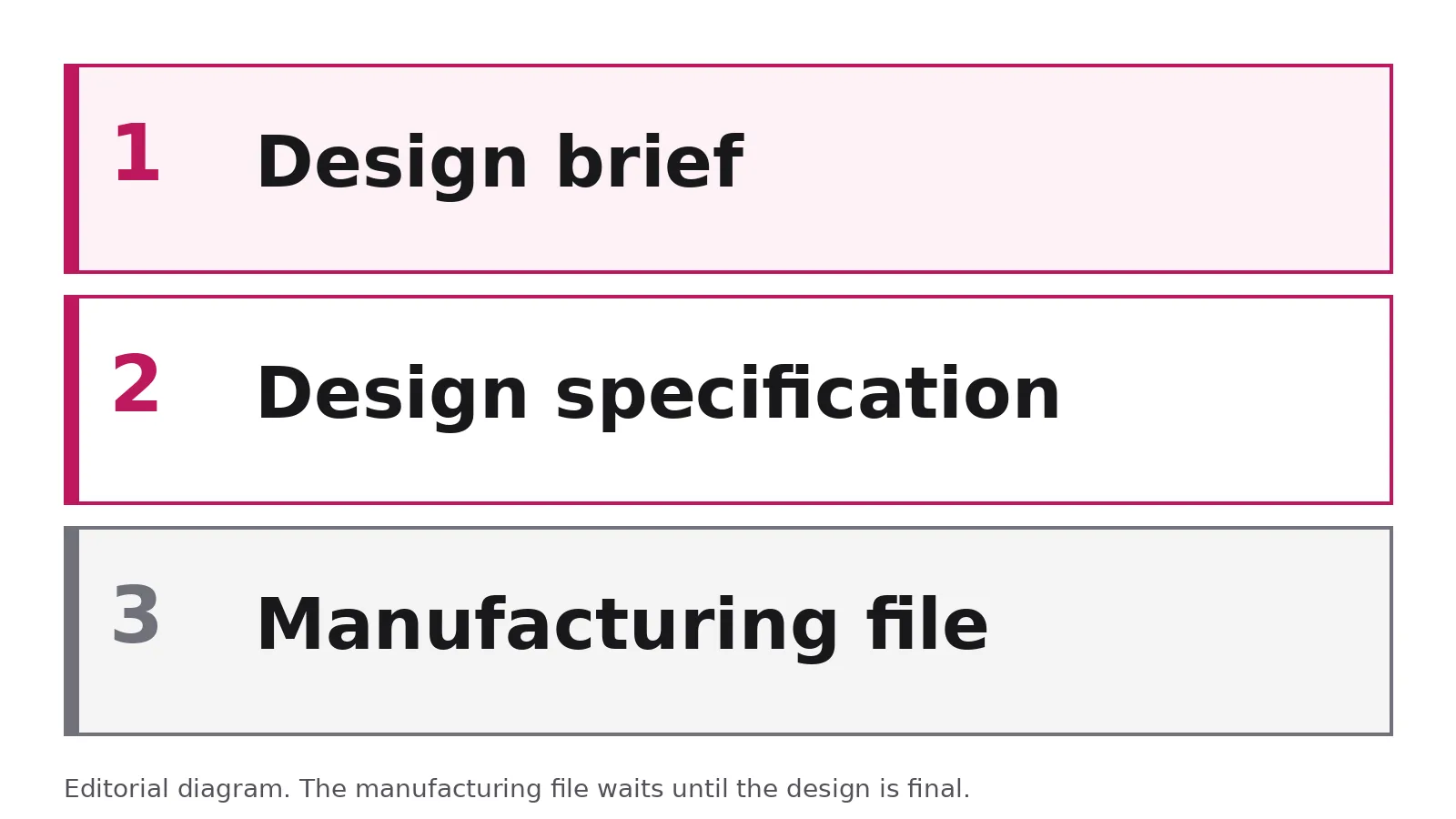
A guessed plus in an empty cell wastes the next build on a concept nobody has watched. A Pugh matrix records whether each concept is better, the same, or worse than a baseline you name. A weighted decision matrix multiplies a rating by a weight and adds those products. The sheets below are an exercise for one fictional desk accessory. Scores, weights, and a winner stay empty.
Use the baseline sheet when you can only say better, the same, or worse than a reference you name. Use the weighted sheet when a rating and a weight both exist and you will multiply them. MIT OpenCourseWare’s Spring 2006 lecture for 15.783J / 2.739J puts both on one slide: criteria, a reference concept, and weightings, then plus, minus, and zero or a 1 to 5 scale (concept-selection PDF, saved 11 October 2026). t2informatik, opened 14 October 2026, defines the Pugh matrix as comparison with a basic concept scored 0, and it also multiplies by weights of 1 to 5 or 1 to 10. LogRocket (5 July 2024, copy saved 11 October 2026) treats weighting as optional. The names overlap. The arithmetic does not. These tables leave scores, weights, and any winner empty.
| Input or item | Typical value or source | Why it matters |
|---|---|---|
| Baseline column | A reference concept. t2informatik marks that column 0 on each criterion. MIT calls it the reference concept. | Every other mark is relative to this column. |
| Screening mark | Plus, minus, or zero (MIT process slide). LogRocket also uses S or O for the same. | Better, worse, or the same. Not a measured size. |
| Finer relative scale | t2informatik: minus 1, 0, plus 1; or plus 2 through minus 2; or plus 3 through minus 3. | Still a comparison with the baseline. |
| Weighted product | MIT: sum the weighted scores. t2informatik: multiply each evaluation by its weight, then add. | Either the weight or the rating changes the total. |
| Whether weights are required | LogRocket, 5 July 2024: optional. t2informatik includes a weight column in its Pugh description, on a 1 to 5 or 1 to 10 scale. | Agree the rule before anyone fills a cell. |
| Unknown cell | Leave it empty on this page. | A blank is not a zero. On these pages, zero means the baseline, or “same as the baseline.” |
| Sensitivity | MIT caveats slide: check the selection against the weightings and the ratings. | One evidenced change can reorder concepts. An empty sheet has no order. |
| Result you are allowed to keep | MIT process slide: combine and improve. A later slide says the goal is to develop the best concept, not only to select one. | Empty cells do not name that concept. |

How does a Pugh matrix differ from a weighted decision matrix?
The baseline sheet records a comparison with one reference. The weighted sheet records a product. Sources use “Pugh matrix” for both, so the columns have to show which operation you mean.
| Decision factor | Baseline sheet | Weighted sheet |
|---|---|---|
| What a filled cell would mean | Better, the same, or worse than the baseline. MIT uses plus, minus, and zero. LogRocket uses plus, minus, and S or O. | A rating times a weight. MIT sums those weighted scores. t2informatik describes the same multiplication. |
| Baseline | One reference concept. t2informatik sets that column to 0. | The same concepts can sit here. Weights are their own column, still empty on this page. |
| How a total is made | MIT’s screening example counts pluses, sames, and minuses, then a net. This page does not copy that count. | Sum of the products. This page does not compute one. |
| What the total is | A relative tally. LogRocket says the number is for comparison, not an absolute value. | A relative sum, with the same limit. |
| Objectivity | t2informatik: the matrix cannot guarantee that the criteria, weightings, and assessments were objective. | That sentence on the same page covers any weighted decision matrix. |
| Cell with no observation | Leave it blank | Leave it blank |
MIT’s funnel slide orders the work as concept generation, then screening, then scoring, then testing. In that lecture, screening and scoring are steps, not two names for one grid. t2informatik folds the weight column into the Pugh matrix and still compares each alternative with the basic concept. LogRocket keeps the baseline comparison and calls the weights optional. PPE Headquarters, on a page updated 25 April 2024 and read from the copy saved 11 October 2026, uses decision matrix, weighted decision matrix, Pugh matrix, and grid analysis as names for one tool. Its demonstration is a job choice, with importance levels of 8, 9, and 6 out of 10. Those weights belong to that employment example. They are not ratings of a desk accessory, and this page does not reuse them.
Takeaway: Name the operation in the column header. A plus is not a weighted product, and a source that shares the name has not made them the same.
Which sheet do you open first?
Open the baseline sheet when better, same, or worse is all you can say. Open the weighted sheet only on a criterion where the weight and the rating each have a source. If the team cannot say what the criterion means, stop. MIT’s outcomes slide calls that “no consensus” and points back to needs, not to a finer scale.
LogRocket says the baseline is often the current solution, and that any alternative can be the baseline because the comparisons are relative. In this exercise the baseline is the desk with no added part. That is a label for the reference column. It is not a score for the desk.
The same outcomes slide names two other results. A green light means the team agrees on a superior concept. Conditional consensus means some criteria still need information, or market or technical feedback. An empty cell is the second result. Filling it so the sheet looks finished would skip the feedback the slide asks for.
Takeaway: Agree what a criterion means before you argue about a mark. An undefined criterion goes back to the need, not into a total.
What belongs on the two sheets for one desk problem?
The objects are fictional labels so both sheets share one set. They continue a made-up study-desk problem from the design brief and specification worksheet: during a seated session a charging cable slides off the desk. That page keeps the part name on a concept list. Three labels sit on the list here.
- Concept A, a binder clip at the desk edge
- Concept B, a short wooden channel the cable can sit in
- Concept C, a cotton cord loop
No row below is a test. That worksheet already names the outcome and the check. This page does not add a threshold it left open.

Baseline sheet
The reference column is the desk with no accessory. Method pages mark a reference as 0 to mean “this is the comparison point.” The concept cells stay empty. A plus would mean better than that desk, a minus worse, a zero the same. Those marks are not entered.
| Criterion | Evidence that would fill the cell | Baseline: desk, no accessory | Concept A clip | Concept B channel | Concept C cord loop |
|---|---|---|---|---|---|
| Cable stays on the desk for the seated session | Watch one session on one real desk edge | reference | |||
| A closed laptop still sits flat beside the part | Set one closed laptop down and look along the desk | reference |
Read “reference” as the comparison point, not as a quality score. Read an empty concept cell as empty. Do not treat the gap as a zero, and do not treat a zero you did not write as “the same.”
Weighted sheet
A weighted score is a rating times a weight. If either number is missing, the product stays empty. MIT’s scoring example, on the following lecture slide, uses percentage weights and ratings on a 1 to 5 scale for a dose-metering device, then ranks those concepts. That table is theirs. It is not copied here, and its rank is not a result for the clip, the channel, or the cord.
| Criterion | Evidence that would fill the cell | Weight | A rating | A product | B rating | B product | C rating | C product |
|---|---|---|---|---|---|---|---|---|
| Cable stays on the desk for the seated session | The same session as the baseline sheet | |||||||
| A closed laptop still sits flat beside the part | The same laptop check | |||||||
| Column total | Add the products only after every cell in that column has a source |
Takeaway: Copy the rows onto your own notes. Write a mark only in a cell whose evidence line you have already run.
What do you recompute when one input is still unknown?
MIT’s caveats slide says to check sensitivity to the importance weightings and the ratings. That check needs a value in the cell. Every concept cell on this page is empty, so there is no ranking to reverse and no winner to defend.
| Cell you would change | Evidence that would justify a mark | What you recompute after that evidence exists |
|---|---|---|
| One criterion on one concept, on one sheet | The check named in that row | The plus, same, and minus counts on the baseline sheet, or that one product and its column sum on the weighted sheet |
Change one cell after the evidence exists. Leave the other cells empty. LogRocket’s tally, when you are using weights, multiplies the mark by the weight and then adds. The article says the result is relative. A second concept that looks close is a prompt to combine features. MIT’s process slide calls that step combine and improve, and the later goal slide says the aim is to develop the best concept, not only to select one.
PPE Headquarters describes sensitivity by moving weight sliders on its job-choice calculator. That calculator is not a score for these three desk objects.
Takeaway: Sensitivity starts after one evidenced cell changes. An empty total is not a tie, and it is not a win.
When does this comparison not apply?
One concept does not need a matrix. Run the single check on the brief page.
An undefined criterion does not need a new scale. MIT’s outcomes slide sends that case back to needs.
A choice between fabrication routes does not belong on these sheets. This page does not compare printing with machining.
Cost, safety, and regulatory rows stay off the sheet. None of the four pages read for this article gives a price, a certification, or a measured result for the clip, the channel, or the cord.

What do you do with the first empty cell?
Name the cell that would change which concepts you keep. Build the model that answers that cell. The rapid prototyping loop starts from the question that model has to answer. For this fictional cable, the question is whether the cable stays on the desk through one seated session, on the edge you actually have. A model that only shows the clip you already prefer has not filled the cell. Comments on that unfinished model go on the industrial design critique example. That page turns each remark into the next check and leaves scores blank.
MIT’s efficiency slide says to identify a risk, write the question that would reduce it, and use a model or prototype to get the answer. That is the next line on an empty row.
How this page was put together
Compiled on 14 October 2026 from four public sources. The MIT OpenCourseWare PDF is lecture material for 15.783J / 2.739J, Spring 2006, saved 11 October 2026. t2informatik’s Pugh matrix page was opened live on 14 October 2026. LogRocket’s article is dated 5 July 2024 and was read from the copy saved 11 October 2026. PPE Headquarters’ page says it was updated 25 April 2024 and was read from the copy saved 11 October 2026. The desk objects and the paired blank tables are an editorial exercise. No score, weight, rank, or winner in those tables comes from a test we ran.
Takeaway: Fill a cell only from a check you ran. Confirm any safety, cost, or standards limit in the document that states it.