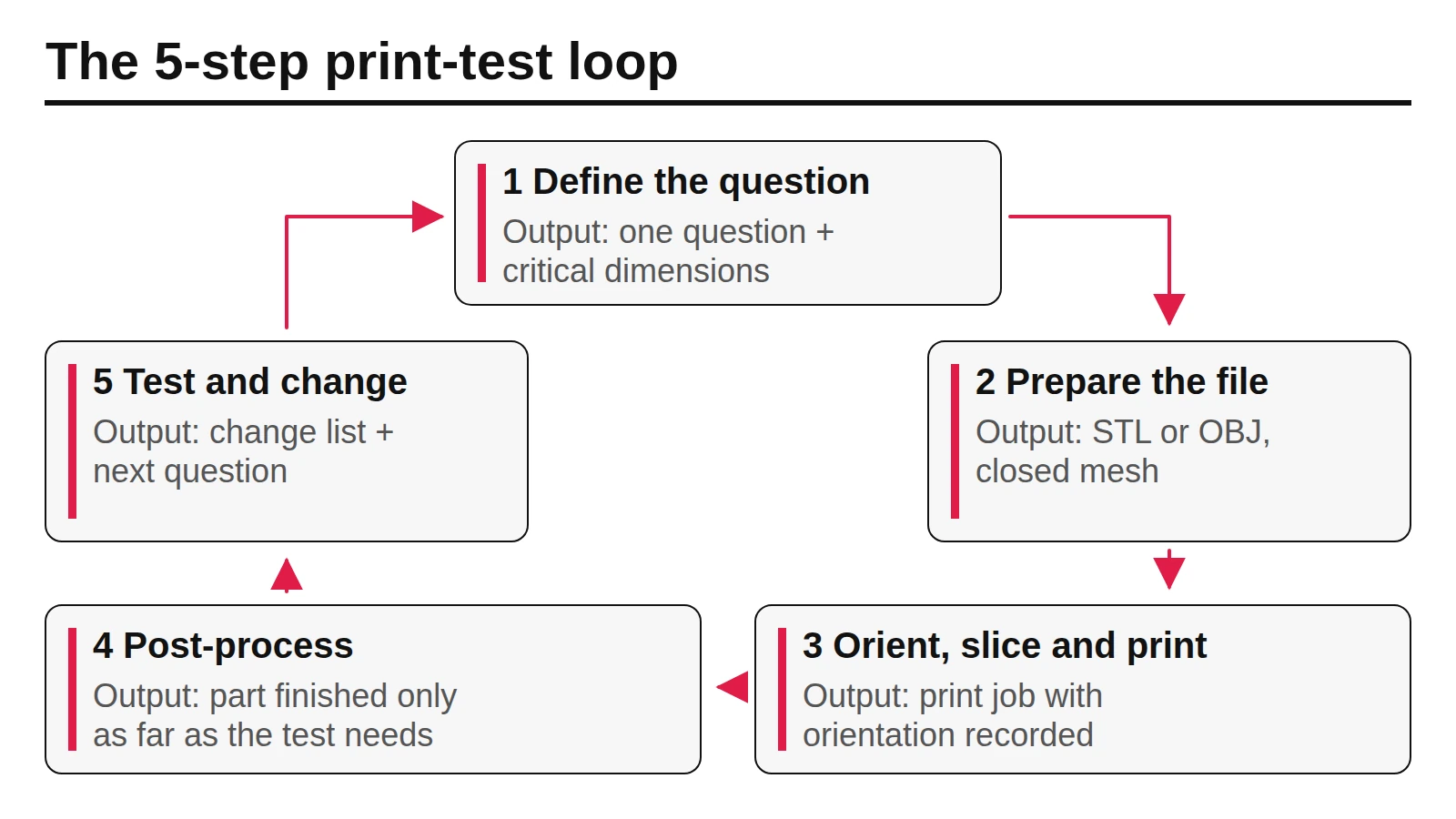
Changing the model, the desk and the instructions together can waste a test because you cannot tell what caused a different result. To do prototype testing, choose a question, identify the build and setup, give a relevant task, record what happens and any help you give, then decide what to change and test again.
Record the build, the setup and every intervention before comparing iterations. This guide is for a formative observation of a low-risk physical object: learning what to investigate next. It provides a session plan, an observation log and a blank worksheet to download. The wooden cable channel is a fictional teaching example; no participant session or performance test was conducted for this article.
Start with a question the model can answer
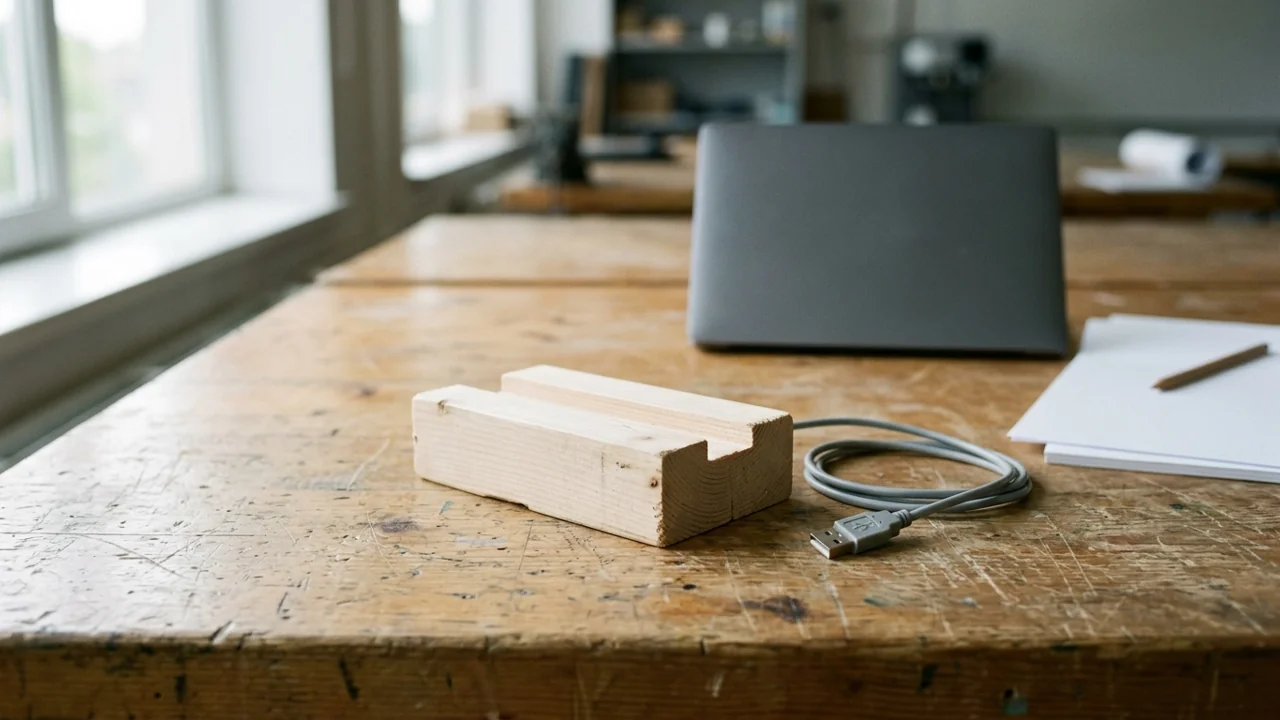
Product prototype testing uses a trial version to investigate a question about the proposed product. Here, the question concerns placing and retrieving a loose cable beside a laptop. It does not concern strength, durability or production readiness.
IDEO.org’s Prototyping Plan Template asks what to learn, whom to learn from and which prompts to use. Its planning categories are the starting point. The build, setup and intervention fields below are our additions for a physical-object session.
The design brief and specification exercise names a broader fictional requirement: keep the cable on the desk through a seated session. This first test tackles a narrower uncertainty: can someone place and retrieve the cable without shifting the closed laptop or needing a demonstration? It cannot settle the full retention requirement. The observation period and relevant desk conditions for that requirement still need defining.
If you are still deciding which kind of model to build, use the rapid prototyping guide first. A shape model can support a placement discussion; it does not automatically represent the final material or mechanism.
Write the session plan before inviting someone
Use the plan to make the question, object and boundaries explicit. Stanford Biodesign’s Prototyping: Build, page 17, explains why interim build records matter: they help teams trace changes and reproduce the object. For a mechanical model it suggests photographs and a parts/materials record, with CAD documentation where available. The table applies that principle without requiring a finished drawing package.
| Plan field | Filled fictional cable-channel plan |
|---|---|
| Learning question | Can a likely user place and retrieve the loose cable without moving the closed laptop or needing a demonstration? |
| Build identity | Exercise build W-A: unfinished wooden channel with an open groove. Attach actual build photographs and a dated sketch before a real session. |
| Parts and known limits | Wooden channel, loose grey cable, closed laptop. Wood species, groove dimensions and finish are unknown; verify on the unit if relevant. No powered connection. |
| Participant context | A person who regularly uses a cable at a desk. Ask about their usual arrangement; do not assume the designer represents that user. |
| Recruitment and access | Choose a recruitment route and record relevant access needs before booking. Participant count and session length remain to be decided for the research question. |
| Initial arrangement | Channel resting freely on the desk; cable beside it, with its end on the tabletop; laptop closed. Photograph positions before starting. No tape or hidden fastener. |
| Task | Put the cable somewhere you would leave it between uses, then pick up its end as if you needed it again. |
| What to record | Placement, retrieval, any cable movement off the desk, laptop movement, requests for help, exact prompts and changes to the arrangement. |
| Roles and recording | Assign a facilitator and a note-taker if available. Agree participation and any recording with the person; use a session code in the log. |
| Ending the task | End after the placement-and-retrieval attempt, or earlier if the participant wants to stop, the object breaks or the task becomes uncomfortable. Record the reason. |
| Decision this can inform | Whether the interaction needs another observation or a revised groove. It cannot approve the finished product. |
Before the real session, rehearse the task and note-taking with a colleague. Label that rehearsal separately so its notes do not become participant evidence. IDEO.org’s planning template also recommends practising before going out to test.
A missing field is a preparation task. If the build is unidentified or the task cannot be performed with it, resolve that before interpreting an observation.
Give the task without teaching the solution
GOV.UK’s moderated usability testing guide concerns services. Its advice to use relevant tasks, neutral instructions and a consistent discussion guide can also inform this physical learning exercise. That is a method adaptation, not a hardware test standard.
Try this short script:
We are looking at the object, and you are free to stop. Put the cable somewhere you would leave it between uses, then pick up its end as if you needed it again. Please tell us what you are thinking as you do that.
Keep the learning question in the observer’s plan. Telling the participant to use the groove, avoid moving the laptop and finish without help would reveal the intended solution. Once the task begins, watch before explaining. If you intervene, write down what you said or moved. A demonstration may help the session continue, but the following attempt has different conditions.
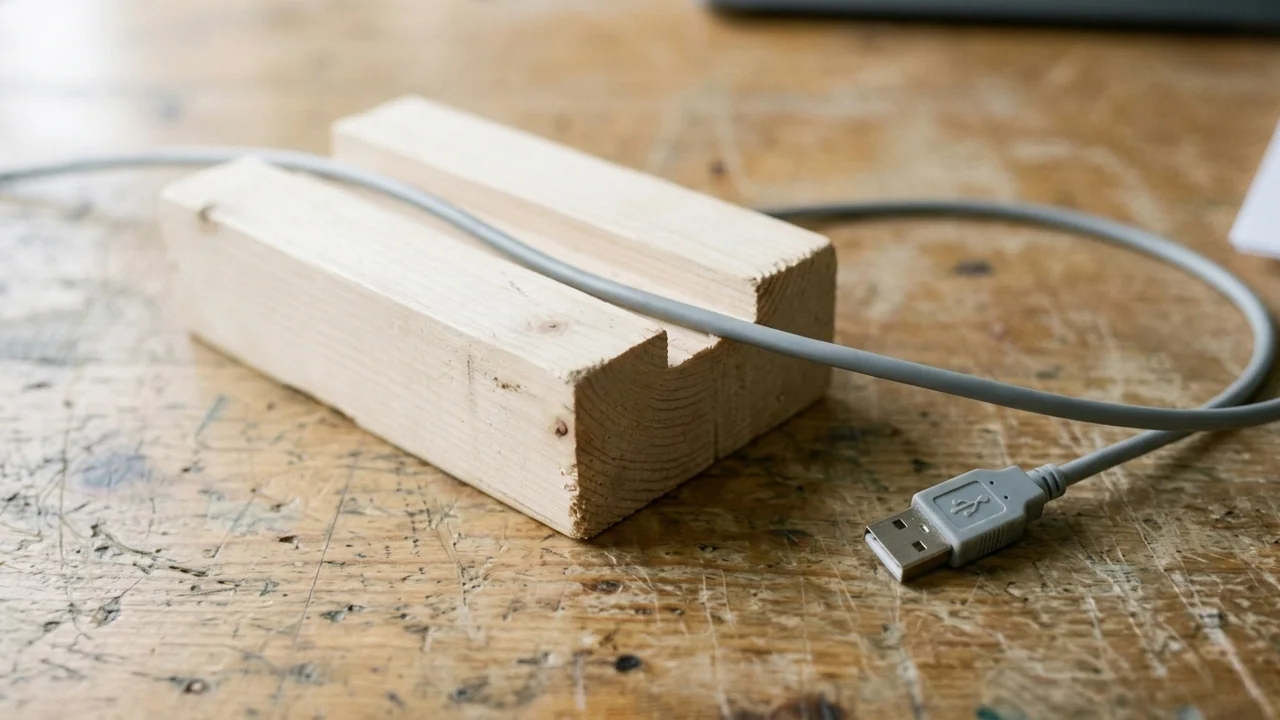
For the channel, note where the cable meets the groove and where its free end starts. A close view can document those positions; it cannot establish how a person will interact with them. The photographs on this page show tabletop arrangements, not recorded test outcomes.
Separate observation, explanation and assistance
Write visible actions and spoken words first. Put possible explanations in a different column. Otherwise, a note such as “the groove is confusing” hides both what happened and what the observer supplied.
The rows below are invented to demonstrate the log. They are not observations from a study. They show how a mid-session intervention changes what can be concluded.
| Event in fictional session S-A | Observed action or words | Assistance or setup change | Possible explanation and next check |
|---|---|---|---|
| Initial attempt with W-A | Person places the cable beside the channel, then asks where it should go. | None before the question. | Intended placement may be unclear, or the task may not match the person’s usual habit. Ask what they expected; do not choose a cause yet. |
| Facilitator intervenes | Facilitator points at the groove; person then places the cable there. | Pointing demonstrated the intended location. Record the exact intervention. | This is assisted placement. Keep it separate from the initial attempt. |
| Arrangement changes | Facilitator tapes part of the cable to the desk before another attempt. | Cable is now restrained by a fixture absent from the plan. Mark a new condition. | Do not attribute a later difference to the wooden channel alone. |
| Result for the broader retention requirement | Not tested by this placement-and-retrieval exercise. |
After the task, ask about an action you could not understand: for example, what the person expected the channel to do. Preserve their words separately from your interpretation. Do not turn a participant’s explanation into a measured property of the object.
For your own session, start with this empty record. Write “none” only when you observed no intervention; an empty cell means it has not been recorded.
| Event / session code | Build and condition | Action or exact words | Help / deviation | Interpretation to check |
|---|---|---|---|---|
Decide what to change and what to hold steady
Stanford d.school’s Experiment Expedition moves from planning and building to gathering information and making choices. IDEO.org’s Build & Run Prototypes likewise recommends a team debrief after a testing round and another iteration. Use the log to make that next choice specific.
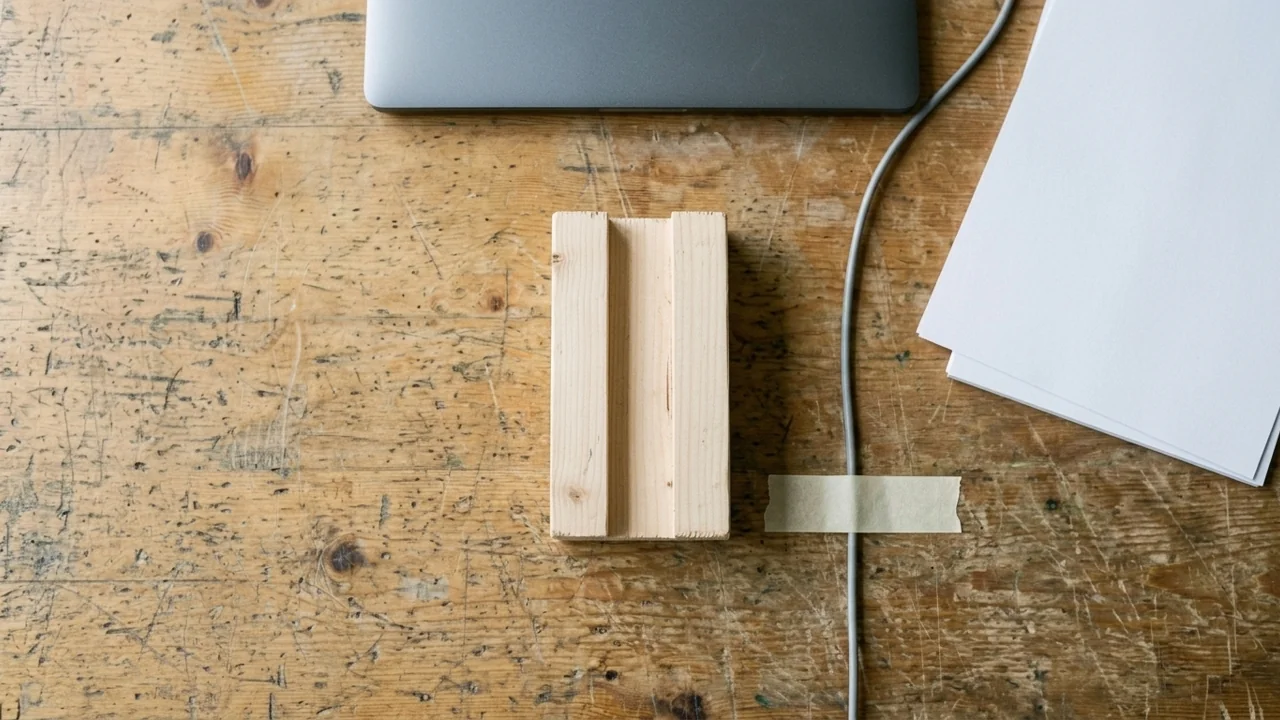
In the fictional log, adding tape changed the setup without changing the channel. Keep that condition visible in the record. If the next question is about the groove, remove the extra fixture for the planned comparison or explicitly make the fixture the subject of a different test.
| Next decision | What the fictional record supports | Next action |
|---|---|---|
| Keep observing W-A | Initial placement and assisted placement differ, but the reason is unresolved. | Repeat the neutral task in a separately logged session; capture expectations after the attempt. |
| Try a revised groove, W-B | A design change is a hypothesis, not an established improvement. | Identify the changed feature and photograph W-B. Keep the planned cable, desk arrangement and task consistent; log differences that cannot be held steady. |
| Add tape as part of the concept | This would introduce a different cable-restraint arrangement. | Give it a separate condition identity and question. Do not combine its notes with freely resting W-A. |
| Declare the product ready | This exercise supplies no evidence for that decision. | Define the remaining requirements and suitable verification work separately. |
If the same person tries W-B after W-A, record their prior exposure: they have already seen the intended interaction. A smoother attempt could reflect that experience as well as the design change. Keep the conclusion at the level the record permits, such as “investigate placement cues next,” rather than “W-B is better.”
Copy the blank plan for your next session
Download the blank prototype-testing worksheet as a Markdown file to edit or print. It includes these plan fields, the observation log and a next-test decision record. It contains no prefilled outcomes.
| Session plan field | Your entry |
|---|---|
| Question and requirement reference | |
| Build ID, date, photos and known limitations | |
| Participant context and relevant access needs | |
| Recruitment, session length and recording agreement | |
| Starting arrangement and items held steady | |
| Neutral task wording | |
| Facilitator / note-taker and recording method | |
| End and stop conditions | |
| Decision the session can inform |
End the session record with the question still open, the change proposed, who will prepare it and which conditions must be retained. If a result is missing, leave it missing. The physical-model critique example can help turn comments into questions before the next test.
Method, sources and limits
Prepared on 15 October 2026 from the primary sources linked above, retrieved that day. Design Kit supplies learning-question and discussion planning; Stanford Biodesign’s 2021 guide supplies interim-build documentation principles; Stanford d.school supplies an iterative learning framework. GOV.UK’s guide, updated 3 October 2017, informs facilitation only. These are public educational methods, not an endorsement of this worksheet.
The tables, session codes, cable-channel scenario and fictional log are original editorial teaching materials. No user results, dimensions, participant-count rule or performance threshold are supplied. This page covers formative interaction learning on a simple unpowered object. It does not provide acceptance, certification, durability, medical, electrical or hazardous-test procedures.