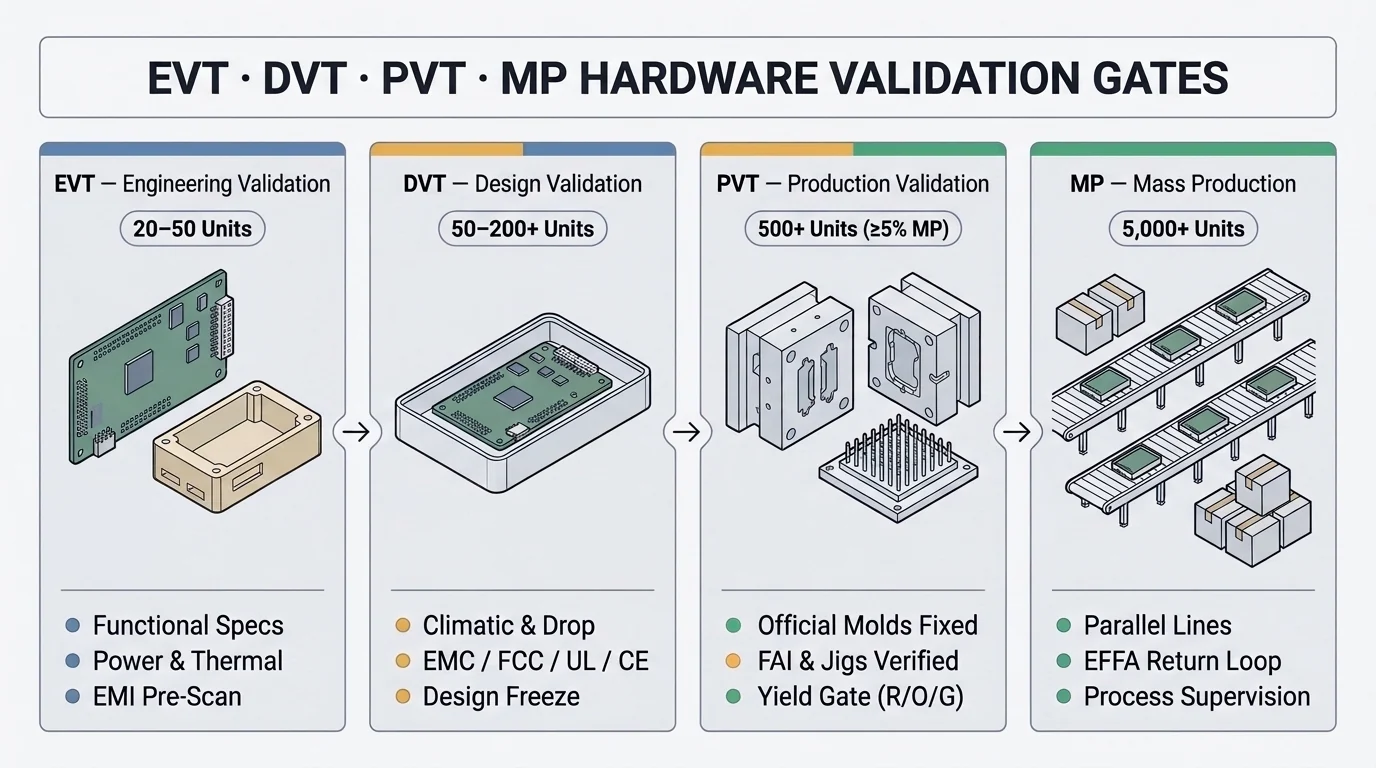
EVT, DVT, and PVT are the three sequential hardware validation gates between early prototyping and mass production (MP). EVT verifies basic functional specifications on 20 to 50 engineering prototypes, DVT validates environmental durability and regulatory compliance on 50 to 200 production-intent units before mold freeze, and PVT proves factory line yield on 500 or more pilot units.
Hardware validation testing acts as a phase-gate process that determines whether a piece of hardware meets the requirements set for its stage of maturity and passes defined criteria before moving toward industrialization, according to Formlabs. Identifying and resolving design problems early in the cycle keeps hardware programs on time and within budget instead of uncovering performance failures when the product is ready to ship, as documented in the Wikipedia Engineering validation test overview. For earlier concept fabrication workflows, see our guide on what rapid prototyping covers, or review broader program reviews in product design and process stage-gate milestones and the full hardware engineering blog.
EVT, DVT, PVT, and MP Tooling State, PCB Hardware, and Validation Responsibility Matrix
| Phase | Typical Volume (Units) | Enclosure & Tooling State | PCB Hardware State | Primary Validation Focus & Owner |
|---|---|---|---|---|
| EVT | 20 to 50 units | Additive manufacturing (SLS, SLA), CNC machining, or silicone and 3D-printed soft molds | Oversized Big Boards for debugging or industrial hot-stake PCBs | Engineering team verifies basic functional, power, thermal, and EMI pre-scan specs and prepares DFM BOM for CM RFQs |
| DVT | 50 to 200 units (1,000+ units on large projects) | Laser-carved resin, soft molds, 3D prints, aluminum molds, or CM first hard tool | Sized, debugged, and denoised form-factor PCB fitted inside enclosure | Engineering and CM validate full climatic, mechanical, reliability, MTBF, safety, and EMC/FCC compliance before mold freeze |
| PVT | 500+ units (at least 5% of initial MP run) | Fixed official production molds and hard tooling with no further design changes | Production PCBs undergoing first boot and firmware inspection | Contract manufacturer validates assembly jigs, test benches, FAI, FMECA, QA/QC, line speed, scrap rate, and daily yield |
| MP | 5,000+ units (scaling to millions) | Replicated parallel production lines under strict tooling supervision | Full production PCBs with ongoing EFFA analysis on early returns | Factory and engineering maintain yield stability, track field returns via EFFA, and block unapproved tooling or parameter shifts |
What Does EVT Mean and What Specifications Does It Verify?
EVT stands for Engineering Validation Test or Engineering Verification Test, and it runs on the first working engineering prototypes to confirm that the basic unit performs to predetermined design goals and specifications. Teams typically produce 20 to 50 beta units designed for manufacturing (DFM) to verify functional, power, thermal, and electromagnetic interference (EMI) baselines before committing to production tooling.
Engineering terminology separates two distinct checks during this stage: verification ensures that a design meets requirements and specifications, while validation ensures that the created entity meets user needs and objectives, as defined in the Wikipedia Engineering validation test reference. In the prototyping stage, engineers build actual working samples and execute EVT to confirm predetermined specifications and flag subsystems needing revision.
Pre-EVT Proof of Concept vs. EVT Engineering Prototypes
Before entering EVT, Formlabs distinguishes proof of concept (POC) prototypes that test an initial idea, method, or product to demonstrate real-world feasibility from working prototypes that show mechanics, design, and user experience. Early hardware rounds rely on focused prototypes that embody only part of a product’s requirements as a looks-like model, a works-like model, or a partial form-and-function model, whereas an engineering prototype incorporates all requirements and functionalities.
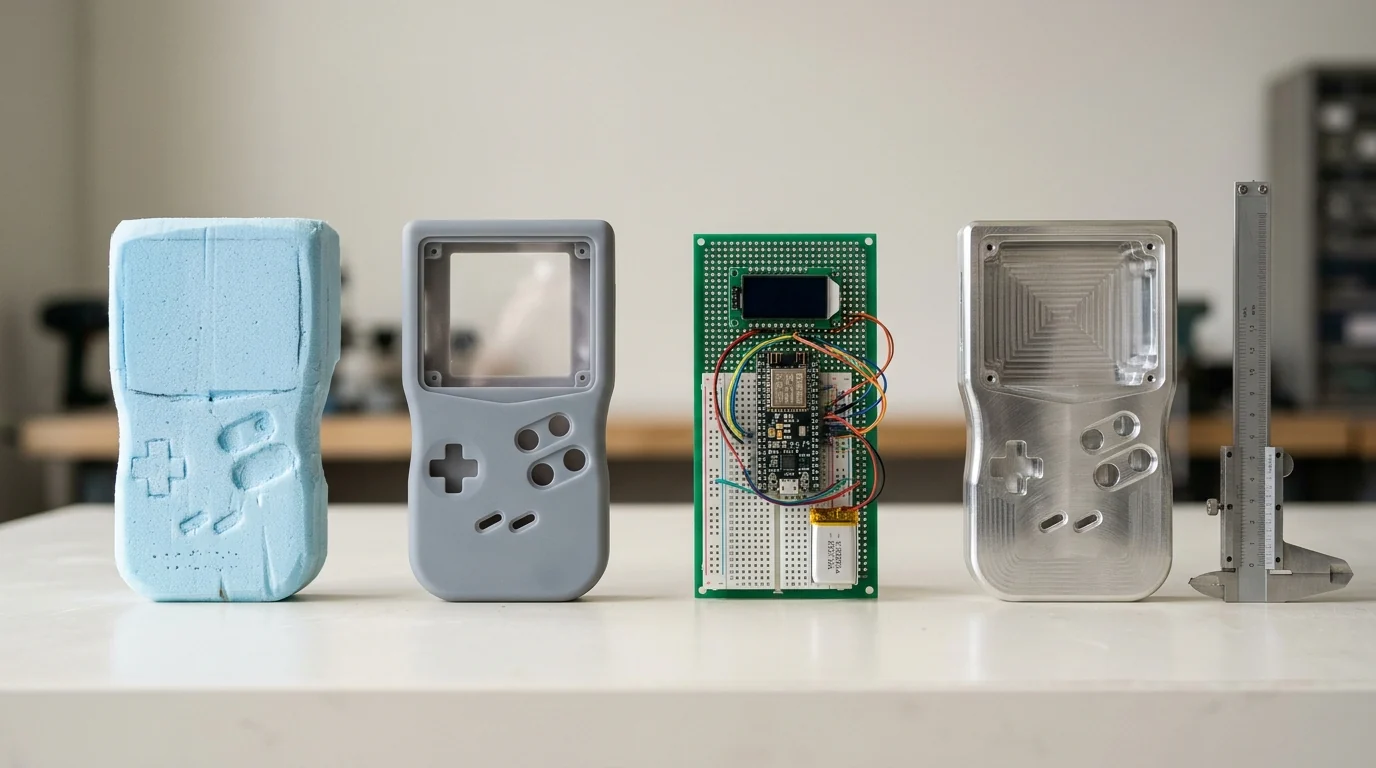
During early exploration, teams frequently build non-form-factor (NFF) models—oversized versions of a product design created to house placeholder functional components and rudimentary electronics such as hardware development kits, Arduino, or Raspberry Pi assemblies. Historical prototype iteration counts vary widely with mechanical risk, ranging from 80 foam models built in 1987 for an ergonomic computer mouse to 5,127 prototypes built over 15 years to develop a cyclone vacuum cleaner, as cited by Formlabs.
Whereas early prototyping yields a limited alpha prototype, EVT develops an engineering-level beta prototype designed for manufacturing (DFM) with functional scope typically governed by a build matrix. ResearchMFG notes that EVT commonly uses oversized prototype circuit boards called Big Boards to test and debug hardware circuit designs, although minor modifications to an existing product with few new technologies can simplify or even bypass EVT.
EVT Bench Tests, BOM Setup, and Contract Manufacturer RFQs
Early EVT bench verification covers basic functional tests, power measurement, signal quality tests, conformance tests, electromagnetic interference (EMI) pre-scans, thermal and four-corner tests, and basic parametric specification verification. At initial circuit board bring-up, hardware engineers also perform a literal smoke test by plugging in a new board and turning on power; if visible smoke appears from the board, power is turned off immediately without further testing, as noted in the Wikipedia overview of smoke testing.
Alongside bench testing, Formlabs outlines four sourcing deliverables completed in EVT: running a make-buy analysis for assembly components, building a bill of materials (BOM) for requests for quotation (RFQs) to contract manufacturers (CMs) ahead of first shots (FS) tooling, developing industrial hot-stake PCBs, and fabricating 20 to 50 production-worthy units via additive manufacturing, CNC machining, or soft-tooling casts such as silicone or 3D-printed molds.
What Do DVT and PVT Stand For and How Do They Differ?
DVT stands for Design Validation or Verification Test, while PVT stands for Production Validation or Verification Test. DVT builds 50 to 200 units (or over 1,000 on large projects) to validate product reliability, enclosure fit, and regulatory certifications before design freeze, whereas PVT builds 500 or more units on frozen official molds to stabilize factory yield.
In DVT, the engineering focus shifts from architecture-level feasibility to full-device industrialization against Original Equipment Manufacturer (OEM) requirements. Engineers verify functional and usability behavior, performance, climatic and environmental durability, mechanical strength, Mean Time Between Failure (MTBF) prediction, Electromagnetic Compatibility (EMC) certification, and safety certification so the product design can be locked.
In PVT, the product design and hard tooling are completely fixed with no further changes to product geometry or official production molds, shifting execution primarily to the contract manufacturer. Efforts concentrate on validating assembly jigs, testing fixtures, and test benches before the production pilot (PP) begins, then optimizing line speed, operator expertise, scrap rate, and daily yield to produce sellable units equal to at least 5% of the first production run.
Sub-Iterations and Equivalent OEM Pilot Labels
Hardware pilot-run stages can be divided into multiple iterations such as EVT1 and EVT2 when needed, according to ResearchMFG. Every pilot-run build requires on-site support from both research and development engineers and manufacturing engineers, especially when coordinating a production line at an outsourced Electronic Manufacturing Services (EMS) facility.
Across global electronics supply chains, different hardware manufacturers also label equivalent pilot-run sequences SR/ER/PR, C0 to C6, or A-Run, B-Run, and C-Run. Despite different shorthand, these programs apply the same underlying validation concepts and phase-gate steps.
How Does Hardware PVT Differ from Software Build Verification?
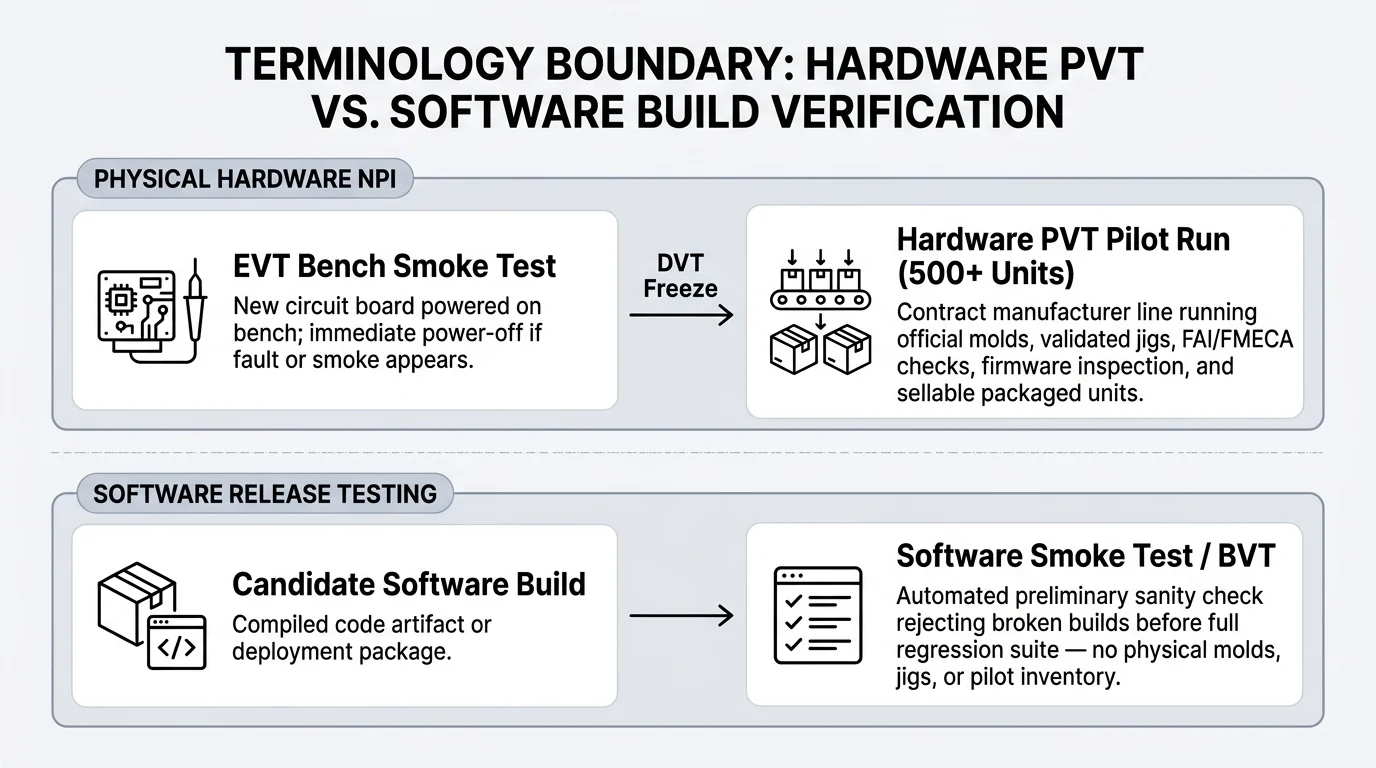
Hardware PVT is a physical pilot manufacturing run of 500 or more units on fixed official molds and validated assembly jigs at a contract manufacturer, whereas software build verification testing (BVT) or smoke testing is a preliminary check on a software release. Software BVT rejects broken builds before broader test suites run, without physical molds or factory yield gates.
In software engineering, smoke testing—also called confidence testing, sanity testing, or a build verification test—runs a preliminary subset of test cases to reveal simple failures severe enough to reject a prospective release before executing full regression suites, according to Wikipedia on software smoke testing. Because software teams sometimes refer to post-deployment sanity checks as production verification testing, cross-functional teams can confuse the two disciplines.
The shared terminology traces directly back to electronics benches: in electronic hardware testing, plugging in a new circuit board and turning on power constitutes a smoke test, where visible smoke triggers an immediate power shutoff with no further testing. In physical hardware NPI, that quick power-on check happens during early board bring-up, whereas hardware PVT occurs only after DVT design freeze, when official production tools replace manual EVT craftsmanship and all assembly jigs and fixtures are verified for mass-production capacity.
What Tooling and PCB Hardware Run in EVT, DVT, and PVT?
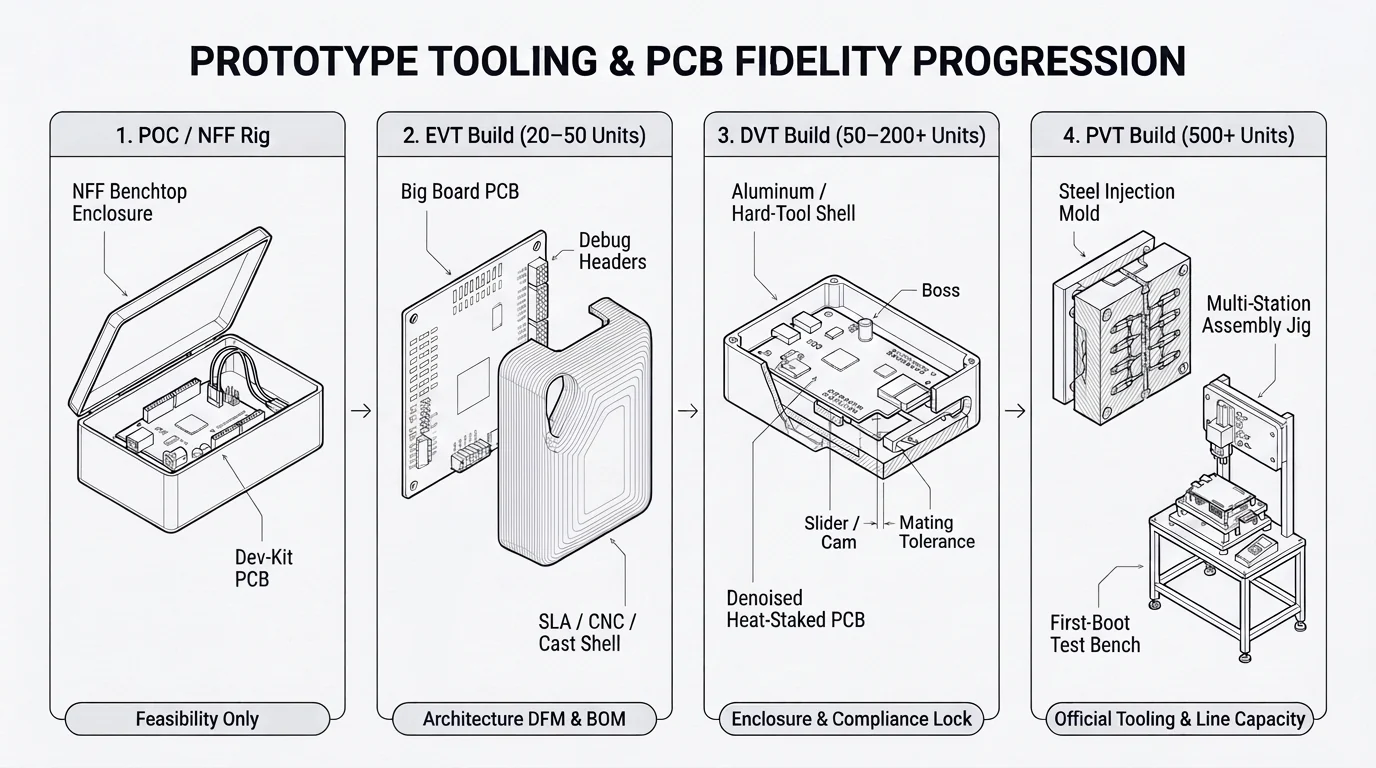
Prototype tooling and circuit boards progress across three fidelity steps: EVT pairs oversized Big Boards or industrial hot-stake PCBs with SLS, SLA, CNC, or silicone-cast shells; DVT pairs sized, denoised PCBs with laser-carved resin, soft molds, aluminum molds, or first hard tools; and PVT runs locked official production molds with capacity-verified assembly jigs and test benches.
Formlabs maps this physical progression across consumer hardware builds beyond the initial mockup: EVT builds rely on SLS and SLA 3D printing, CNC machining, or casts from silicone and 3D-printed molds to deliver 20 to 50 engineering units. In DVT, ResearchMFG explains that engineers fit the sized PCB inside a mechanical enclosure made from laser-carved resin, soft molds, or 3D printers to validate complete device functionality before investing in production molds, while Formlabs adds that PCBs undergo debugging and denoising as the CM builds first hard tools or uses aluminum molds to optimize surface finish, materials, tolerancing, sliders, cams, joining methods, and process parameters.
In PVT, manual EVT craftsmanship disappears entirely: all components must be manufactured with official molds or production tools, assembly procedures follow established manufacturing standards, and the quantity of assembly jigs, testing fixtures, and production equipment is verified against mass-production capacity requirements.
Mold Defects and the Premature Hard-Tooling Trap
Even a simple molded plastic part can exhibit sink marks, flow lines, weak areas from heterogeneous cooling, insufficient space for legally required labels, or mating-part tolerance issues after initial molding, according to Formlabs. DVT exists to resolve these mechanical and assembly details—including heat-staking a PCB to its plastic enclosure with integrated rivets, integrating an injection-molded enclosure into a fabric substrate, and verifying corrosion resistance in salt fog environmental chambers—before steel molds are locked. Review structural part rules in our guide on design for manufacturing principles before releasing first-shot drawings.
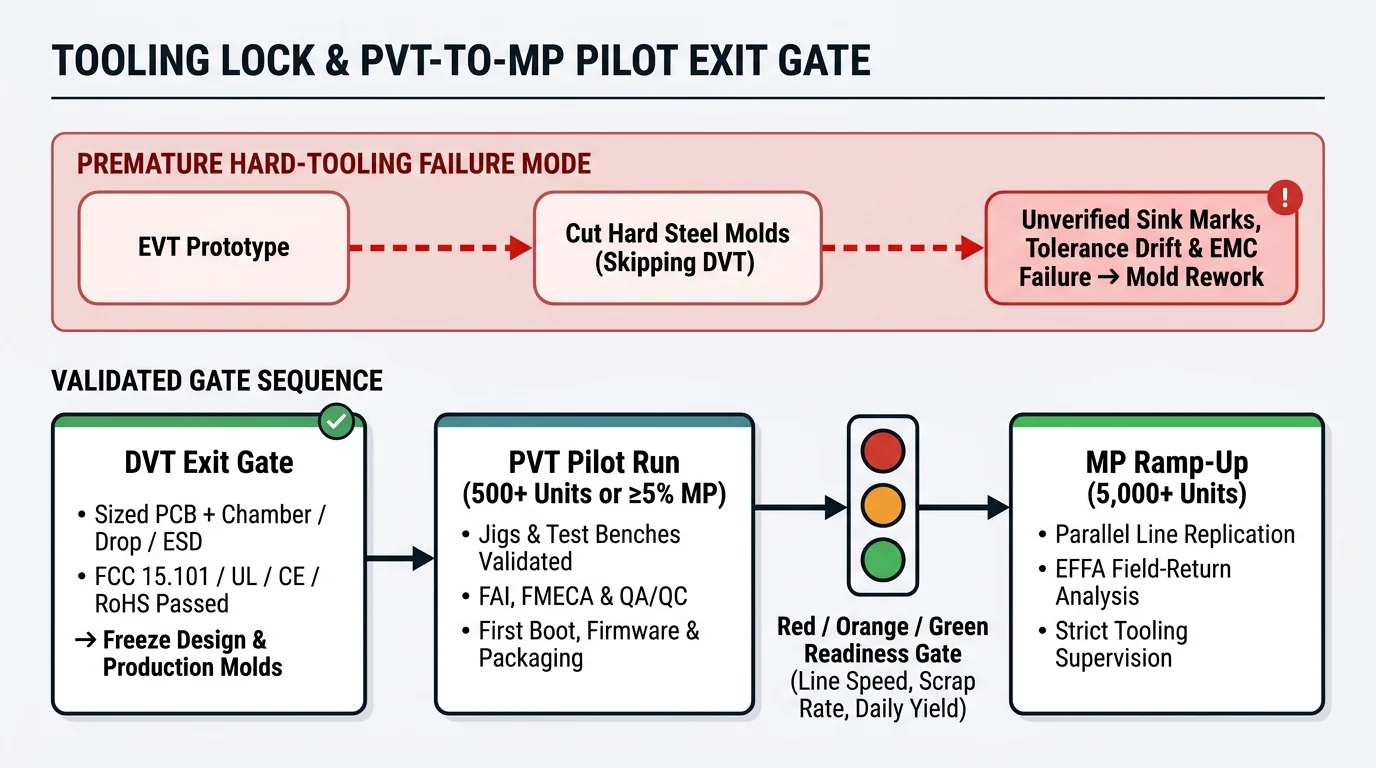
Bypassing the DVT stage by investing in hard tooling at the end of EVT carries enormous risks because it commits PVT-scale resources prematurely before enclosure fit, molded cosmetics, and regulatory compliance are proven. Formlabs notes that cutting corners in this way is rarely advised because any design change uncovered afterward forces rework on finished production molds.
How Does the Pilot Line Transition from PVT to Mass Production?
A pilot line transitions from PVT to mass production (MP) once 500 or more sellable units—or at least 5% of the first production run—verify yields at production speeds on frozen hard tooling. Teams exit PVT using red, orange, and green metrics after validating jigs, first-article inspection (FAI), FMECA, QA/QC, firmware first-boot, and packaging before ramping MP at 5,000+ units.
During PVT, most execution occurs inside the contract manufacturer’s factory. Formlabs notes that CM teams identify single-source component risks through formal protocols including Failure Modes, Effects, and Criticality Analysis (FMECA), QA/QC controls, and FAI, while electronics complete their first boot and firmware inspection alongside finalized retail packaging and user manuals.
Tailoring Entrance and Success Criteria Before MP Ramp
Rigorous phase gates separate entrance readiness from exit approval rather than relying on informal sign-offs. Under sections G.1.1 through G.1.3 of NASA Appendix G on life-cycle and technical review criteria, technical review entrance and success criteria are expected to be tailored to each project to demonstrate acceptable technical maturity, adequacy of technical planning, credibility of budget, schedule, and risks, and readiness to proceed to the next phase.
Once PVT metrics turn green, MP ramp-up typically begins at a minimum quantity of 5,000 units and can scale to millions of units by replicating the validated initial production line in parallel. Throughout MP, Formlabs emphasizes tracking early failed field returns through Early Field Failure Analysis (EFFA) and maintaining factory supervision so vendors do not introduce unapproved tooling or process parameter shifts.
Which Functional, Environmental, and Compliance Tests Belong in Each Phase?
Assign bench-level functional, power, signal quality, four-corner thermal, and EMI pre-scan checks to EVT; run climatic, salt fog, thermal cycling, vibration, drop, ESD, wear, MTBF, safety, and formal regulatory certifications including FCC, UL, CE, and RoHS in DVT; and execute automated assembly-line first-boot, firmware inspection, FAI, FMECA, and QA/QC yield verification in PVT.
Timing regulatory testing correctly prevents both premature lab retests on non-final prototypes and illegal early shipment. Under 47 CFR § 15.101(a) on eCFR, unless exempted in sections 15.23, 15.103, or 15.113, unintentional radiators must complete equipment authorization via certification or Supplier’s Declaration of Conformity (SDoC) under subpart J of part 2 prior to the initiation of marketing. Running EMI pre-scans on EVT hardware catches layout noise early so first production-level DVT units can pass formal FDA, FCC, UL, CE, EC, and RoHS compliance along with biocompatibility, chemical resistance, aging, radiation, cosmetic, wear, and drop evaluations. To structure individual lab test logs across these builds, use our physical prototype testing plan.
EVT, DVT, and PVT BOM Status, Test Scope, and Phase-Exit Criteria Checklist
| Validation Phase | BOM & Sourcing Status | Core Test Scope | Mandatory Phase-Exit Gate Criteria |
|---|---|---|---|
| EVT (20 to 50 units) | Make-buy analysis complete; DFM-oriented BOM issued for CM RFQs ahead of first shots (FS) tooling | Board bring-up smoke test, basic functional, power, signal quality, four-corner thermal, parametric specs, and EMI pre-scans | Beta engineering prototype meets predetermined build-matrix specifications and identifies revisions before enclosure tooling |
| DVT (50 to 200+ units; 1,000+ on large projects) | Production-intent BOM; denoised PCB and molded parts verified for surface finish, tolerances, labels, and joining | Climatic and salt fog chambers, thermal cycling, vibration, drop, ESD, wear, cosmetic, biocompatibility, chemical, aging, radiation, MTBF, EMC, safety, and FCC § 15.101 / FDA / UL / CE / EC / RoHS certifications | Complete device passes OEM reliability and regulatory requirements; product design and official production molds are frozen |
| PVT (500+ units or >=5% of initial MP) | Locked production BOM; single-source component risks audited via FMECA, QA/QC, and FAI | First-article inspection (FAI), electronics first boot, firmware inspection, retail packaging and manual verification, and line-speed yield checks | Assembly jigs, test fixtures, and equipment verified for MP capacity; red, orange, and green yield and scrap metrics turn green for 5,000+ unit MP ramp |
Sources
- Engineering validation test — Wikipedia
- Smoke testing (software) — Wikipedia
- Appendix G: Life-Cycle and Technical Review Entrance and Success Criteria — NASA
- 47 CFR § 15.101 Equipment authorization of unintentional radiators — eCFR
- Formlabs — Validation Testing in Product Development: From POC to EVT, DVT, PVT, and Mass Production
- ResearchMFG — Exploring EVT/DVT/PVT: Explaining the Three Crucial Validation Stages in New Product Development